
A collision with a tractor-trailer changes everything in seconds. Suddenly you’re facing mounting medical bills, aggressive insurance adjusters, and a trucking company’s legal team that started building its defense before you even left the hospital. Without an experienced new jersey truck accident attorney in your corner, critical evidence can disappear and your right to fair compensation can quietly erode. This 2026 guide breaks down what New Jersey law requires, the mistakes that cost victims the most, and how Weiner Mazzei protects your claim from day one through final resolution.
Why Truck Accident Cases Demand a New Jersey Truck Accident Attorney
How Truck Accidents Differ From Car Accidents
A loaded tractor-trailer can weigh 80,000 pounds. A passenger car weighs closer to 4,000 pounds. That gap alone changes how a crash gets investigated and resolved. Truck wrecks often involve multiple liable parties, including the driver, trucking company, cargo loader, and even the vehicle manufacturer.
Federal rules add another layer. Trucking companies must follow Federal Motor Carrier Safety Administration regulations covering driver hours, maintenance logs, and drug testing. Car accident claims rarely touch these rules. Sources like the New Jersey Truck Accident Lawyer resource show just how specialized this area of law is.
Evidence disappears fast, too. Black box data, driver logs, and dashcam footage can be erased within days unless someone moves quickly to preserve them.
The Financial and Physical Stakes Involved
Truck crashes often cause catastrophic injuries: spinal damage, traumatic brain injuries, amputations. Medical bills can climb past hundreds of thousands of dollars once you factor in long-term rehab and lost wages.
Insurance coverage layers get complicated fast. Commercial policies frequently carry limits of $1 million or more, with several insurers involved. Figuring out which policy applies takes real skill, similar to the strategies discussed in guides on the best attorney for car accidents new jersey searches, just scaled up considerably.
Because so much money and liability is on the line, early legal help protects evidence, deadlines, and your right to full compensation before companies finish building their defense.
Types of Truck and Commercial Vehicle Accidents We Cover
Truck accident claims cover more ground than most people expect. New Jersey roads carry everything from massive tractor-trailers to small delivery vans. Each crash type brings different evidence, different rules, and a different path to compensation. Knowing the range of scenarios helps injury victims ask the right questions early on.
Tractor-Trailer and Semi-Truck Collisions
These are the crashes most people picture when they think “truck wreck.” A fully loaded semi can weigh 80,000 pounds, making collisions with passenger cars especially deadly. For a closer look at how these wrecks happen, this breakdown of the most common types of large truck accidents covers jackknifes, underride crashes, and rollovers in detail.
Loading, Unloading, and Cargo-Related Accidents
Not every truck accident happens on the highway. Warehouses, loading docks, and delivery sites create their own hazards. These claims often involve:
- Shifting or improperly secured cargo that falls onto workers or nearby vehicles during transport
- Forklift accidents that occur while pallets are being moved on or off a trailer
- Crushing injuries caused by malfunctioning lift gates or dock plates
- Falls from trailers or loading platforms due to missing guardrails or wet surfaces
- Chemical spills or leaks from improperly labeled or packaged freight
Delivery Van and Local Commercial Vehicle Crashes
Local delivery traffic has surged across New Jersey, and crashes involving vans, box trucks, and courier vehicles are climbing right along with it. Firms handling New Jersey Semi-Truck Accident Lawyers cases often see overlap here, since many companies run mixed fleets. Tight delivery schedules and unfamiliar routes raise the risk for pedestrians, cyclists, and other drivers alike.
Common Causes Behind New Jersey Truck Crashes
Driver Fatigue, Distraction, and Speeding
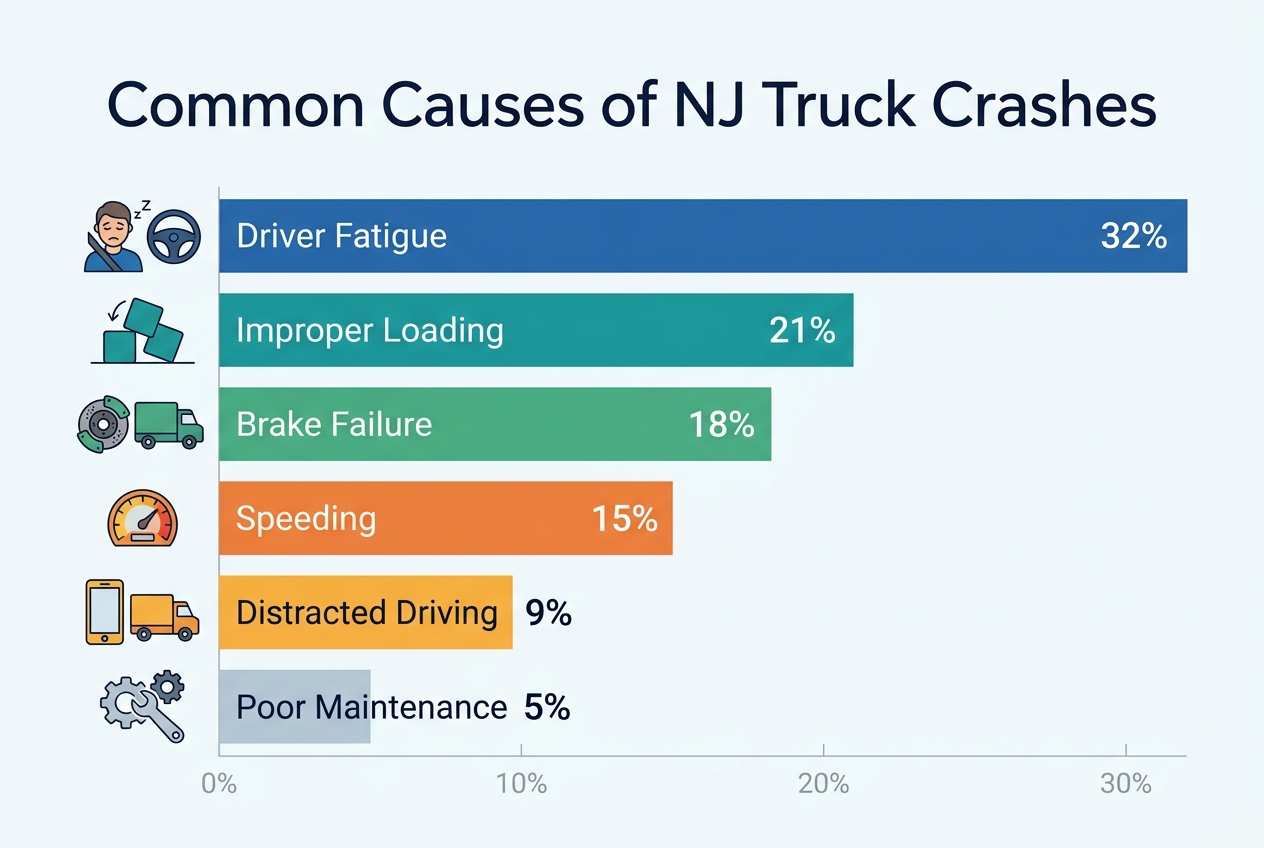
Driver error remains a leading factor in serious truck crashes across New Jersey. Tired drivers push past federal hours-of-service limits to meet delivery deadlines. Reaction times slow. Judgment weakens. A driver who’s been awake for 18 hours can react as slowly as someone who’s legally drunk.
Distraction is another major threat. Phones, dispatch tablets, and food breaks behind the wheel all pull attention off the road. On the New Jersey Turnpike and I-95, a few seconds of inattention at highway speed can end in a multi-vehicle pileup.
Speeding makes all of this worse. Loaded trailers need far more distance to stop. A speeding truck on wet pavement, or in rush-hour traffic on Route 80, often can’t slow down in time — turning a routine commute into a catastrophic collision.
Improper Maintenance and Equipment Failure
Mechanical failure causes a large share of New Jersey truck wrecks. Worn brake pads, bald tires, and faulty trailer hitches often go unnoticed until it’s too late. Federal rules require regular inspections, but some carriers skip them to save time and money.
Poor maintenance creates hidden hazards. A cracked wheel rim or leaking brake line may not fail right away, but it will eventually give out under highway stress. When it does, the results are often devastating for everyone nearby.
Reviewing 10 things to consider when choosing a personal injury att… can help victims understand how maintenance records become critical evidence in these claims.
Company Policies That Push Unsafe Schedules
Trucking companies sometimes put profit ahead of safety. Unrealistic delivery windows pressure drivers to skip rest breaks or falsify logbooks. This company pressure creates dangerous conditions on already crowded New Jersey roads.
Weather adds another layer of risk. Snow, fog, and sudden downpours cut visibility and traction on highways like the Garden State Parkway. Combined with rushed schedules, these conditions raise the odds of a serious crash significantly.
Victims facing these hidden corporate practices may benefit from resources like New Jersey Truck Accident Lawyers | Call 732-247-3600 to better understand their options.
Understanding Trucking Regulations and Federal Oversight
Hours-of-Service and Fatigue Rules
The Federal Motor Carrier Safety Administration, or FMCSA, sets strict limits on driving time. Truckers generally can’t drive more than 11 hours after 10 straight hours off duty. They also face a 14-hour daily work window and mandatory rest breaks. These hours-of-service rules exist because fatigue slows reaction time and clouds judgment behind the wheel.
Many crashes trace back to drivers pushing past these limits to meet tight delivery schedules. Electronic logging devices now track hours automatically, making violations harder to hide. When logs show a driver exceeded legal limits before a crash, that record becomes powerful proof of fatigue-related negligence.
CDL Requirements and Driver Qualification Standards
Commercial drivers must hold a valid Commercial Driver’s License, or CDL, and meet strict qualification standards. That means passing medical exams, drug and alcohol screenings, and skills tests. Trucking companies must also check each driver’s history before hiring them.
Federal rules under commercial trucking regulations require ongoing driver monitoring, not just a one-time check. Companies must track violations, suspensions, and failed drug tests throughout employment. Skip these steps, and an unqualified or impaired driver ends up on the road, raising serious safety risks for everyone sharing the highway.
How Regulatory Violations Strengthen a Claim
Regulatory violations often become the strongest evidence in a truck accident claim. Proof of skipped inspections, falsified logs, or expired licenses can show a pattern of negligence beyond a single mistake.
Resources like Union County Truck Accident Lawyers | New Jersey Semi … highlight how these violations connect directly to liability. A documented safety violation can shift blame toward the carrier, not just the driver, strengthening a victim’s case significantly.
Who Can Be Held Liable After a Commercial Vehicle Accident
The Truck Driver and Employer Responsibility
A commercial vehicle accident often starts with driver error. But the driver’s employer usually shares blame too. Trucking companies must train drivers, monitor hours, and enforce safety rules. When they fail at that, they can be held responsible alongside the driver.
Trucking Companies, Brokers, and Maintenance Contractors
Many parties keep a truck on the road, and each one can carry a share of fault when something goes wrong. A thorough investigation, like one performed by a Newark Truck Accident Lawyer, looks at every link in that chain.
- The trucking company that dispatched the driver without proper rest or training;
- The freight broker that hired an unsafe carrier to save money;
- The maintenance contractor that skipped required brake or tire inspections;
- The cargo loading company that packed freight unevenly, causing a rollover;
- The leasing company that owns the truck but ignored known safety defects.
Manufacturers and Defective Parts Liability
Sometimes the truck itself is the problem. A faulty brake system, tire, or coupling device can cause a crash no driver could have avoided. In these cases, the manufacturer may be liable for the defect. Identifying every responsible party helps victims pursue full and fair compensation.
Truck vs. Car Accident Claims: Key Differences at a Glance
Truck crashes differ from ordinary car accident claims in almost every way. The table below lines up four key factors side by side.
| Factor | Car Accident | Truck Accident |
|---|---|---|
| Insurance Limits | $15,000-$100,000 | $750,000-$5,000,000+ |
| Evidence Type | Photos, police report | Black box, ELD logs, maintenance files |
| Injury Severity | Minor to moderate | Catastrophic, often fatal |
| Investigation Complexity | Single driver | Driver, carrier, shipper, manufacturer |
Insurance Coverage and Policy Limits
Commercial trucking policies carry much higher limits than personal auto coverage. Federal rules often require carriers to hold at least $750,000 in liability coverage, sometimes far more.
Evidence Collection and Black Box Data
Trucks store electronic logging data, GPS records, and inspection reports. This black box data can vanish quickly unless someone preserves it fast — nothing like a simple fender-bender report.
Severity of Injuries and Case Value
A loaded semi-truck can weigh 20 times more than a car. That size gap drives higher case value and greater medical needs. Learn more from this Hackensack Truck Accident Lawyer | Tractor-Trailer … resource on serious crash outcomes.
Steps to Protect Your Rights After a Truck Accident
Immediate Actions at the Accident Scene
The first hour after a crash matters most. Knowing what to do after a semi truck accident can protect both your health and your legal claim. Call 911, get medical care, and photograph the scene, vehicles, and any visible injuries before anything gets moved.
Medical Treatment and Documentation Timeline
Delayed treatment can weaken your claim. Insurance adjusters often argue that gaps in care mean the injury wasn’t serious. Follow a clear timeline instead.
| Timeframe | Action | Why It Matters |
|---|---|---|
| Within 24 hours | ER or urgent care visit | Creates official injury record |
| 3-5 days | Follow-up with primary doctor | Tracks symptom progression |
| 1-2 weeks | Specialist referral, if needed | Documents severity and treatment plan |
| Ongoing | Keep all bills and records | Supports compensation claims |
Mistakes That Can Hurt Your Claim
Never admit fault or say “I’m fine” at the scene. Skip posting about the crash online, and don’t sign anything from the trucking company’s insurer without review. Groups like New Jersey Truck Accident Lawyers often see these early missteps derail otherwise strong cases.
What Compensation Can Truck Accident Victims Recover
Economic Damages: Medical Costs and Lost Income
Truck crash injuries often require extensive medical care. Economic damages cover emergency treatment, surgery, hospital stays, medication, and physical therapy. Victims can also recover costs for future treatment if injuries require ongoing care. These bills pile up fast, especially after a multi-day hospital stay or spinal surgery.
Lost income is another major factor. Truck accidents frequently cause injuries that keep victims out of work for weeks or months. Compensation can include wages lost during recovery and reduced earning capacity if the injury limits future job duties. A construction worker unable to lift heavy materials, for example, may need retraining or a lower-paying role — and that income gap counts too.
Non-Economic Damages: Pain, Suffering, and Disability
Non-economic damages address harm that doesn’t come with a receipt. Pain and suffering compensation reflects physical discomfort, emotional distress, and the daily toll an injury takes. A broken pelvis or crushed limb can cause months of pain that disrupts sleep, mood, and relationships.
Permanent disability also factors into these damages. Victims who lose mobility, sensation, or independence deserve compensation for that lasting change. Someone facing chronic back pain or a permanent limp may never return to their old routine, and the law recognizes that loss.
Special Considerations in Catastrophic Injury Cases
Catastrophic injuries, like spinal cord damage or traumatic brain injury, often require additional compensation categories. These may include home modifications, assistive equipment, and long-term nursing care. Understanding the long term effects from a brain injury helps victims plan for decades of ongoing support, not just immediate recovery.
Family members may also recover damages for loss of companionship or caregiving burden. These cases demand careful calculation, since costs can stretch far beyond the initial hospital stay.
How an Experienced Lawyer Investigates a Truck Accident Claim
Gathering Black Box and Electronic Logging Data
Most commercial trucks carry an electronic control module, often called a black box. It records speed, braking, and engine data in the seconds before a crash. Federal rules also require electronic logging devices that track a driver’s hours behind the wheel.
This data can reveal fatigue, speeding, or hours-of-service violations. Trucking companies sometimes overwrite these records within days or weeks. That’s why sending a preservation letter early matters so much — before the evidence disappears for good.
Working With Accident Reconstruction Experts
Accident reconstruction specialists study skid marks, vehicle damage, and road conditions. They use physics and computer modeling to show exactly how a crash happened. Their findings can explain fault clearly, even when witness accounts conflict.
Maintenance records matter here too. Worn brakes, bald tires, or skipped inspections often point straight to negligence. Combining mechanical evidence with reconstruction reports builds a stronger, more complete claim.
Dealing With the Trucking Company’s Insurance Adjusters
Trucking companies carry large insurance policies, often $1 million or more. Their adjusters move fast, sometimes contacting victims within hours of a crash. They may dangle quick settlements before injuries and losses are fully known.
Understanding why you need a truck accident lawyer becomes clear once these tactics start. A skilled negotiator handles all communication, protects statements from being twisted, and pushes back against lowball offers using solid evidence.
New Jersey Statute of Limitations and Filing Deadlines
Standard Filing Deadlines for Injury Claims
New Jersey law gives injury victims a strict window to act. Understanding personal injury law in new jersey starts with this deadline. Victims generally have two years from the crash date to file a lawsuit. This applies to truck accident claims, car crashes, and most other injury cases. Miss this deadline and you usually lose the right to sue forever, no matter how serious the injuries or how clear the fault. Courts rarely make exceptions once the two years pass, so early action matters.
Exceptions That May Extend or Shorten the Timeline
Some situations change the standard two-year rule. These exceptions can work for or against a victim, so timing details matter:
- Claims against a government entity, such as a state-owned truck or municipal vehicle, require a notice of claim filed within 90 days of the accident.
- Victims who were minors at the time of the crash may have extra time, since the clock can pause until they turn eighteen.
- Cases involving a victim’s mental incapacity may also pause the deadline until that condition improves or is legally addressed.
- Discovery of an injury that was not immediately obvious can sometimes shift the filing period to when the harm was reasonably found.
- Wrongful death claims following a fatal truck crash carry their own two-year deadline, starting from the date of death rather than the accident.
Choosing the Right Attorney for Your Truck Accident Case
Questions to Ask Before Hiring a Lawyer
Before signing anything, ask direct questions. How many truck accident cases has the attorney handled? Has the lawyer taken cases to trial, or does the firm only settle? A strong trial record signals that insurance companies can’t bully the attorney into a low offer. Ask about staffing too. Will a partner handle your case, or will it get passed off to a junior associate?
It also helps to know the basics before that first meeting. Reading about what is a truck accident lawyer gives victims a clearer picture of the role these attorneys play, from investigating wreckage to negotiating with corporate carriers.
Most firms offer a free consultation. This lets victims evaluate fit without financial risk. Bring your questions, listen closely, and trust your gut about communication style.
Experience With CDL and Federal Trucking Standards
Truck cases differ sharply from ordinary car crashes. A qualified attorney should know Commercial Driver’s License requirements inside and out — medical certification rules, hours-of-service logs, endorsement classes for hauling hazardous materials.
Federal Motor Carrier Safety Administration standards govern everything from vehicle inspections to driver rest breaks. An attorney fluent in these rules can spot violations that many general practice lawyers miss entirely. That knowledge often makes the difference between a denied claim and a fair settlement.
Track Record of Settlements and Verdicts
Past results matter. Ask for examples of settlements or verdicts in cases similar to yours. A firm with a documented history of six and seven figure recoveries shows real negotiating leverage against trucking insurers.
Numbers alone don’t tell the whole story, though. Ask how those results were achieved. Did the case settle quickly, or did it take aggressive litigation? A proven, adaptable track record shows the attorney can fight hard whichever path your claim demands.
Frequently Asked Questions About Truck Accident Claims
Do I Really Need a Lawyer if the Insurance Company Offers a Settlement
An early settlement offer often looks tempting. But first offers are usually low. Insurance adjusters know victims face bills and lost wages, and they count on that pressure. A quick check-in with a lawyer costs nothing and can reveal whether the offer covers your real losses, including common truck accident injuries that require months of treatment.
How Long Does a Truck Accident Case Take to Resolve
Timelines vary based on injury severity and how many parties are involved. Several factors shape the schedule:
- Minor crashes with clear liability may settle within a few months once medical treatment ends.
- Cases involving catastrophic injuries often take a year or longer, since future medical needs must be fully understood first.
- Disputes over fault between the driver, trucking company, and cargo loader can add extra months of investigation.
- Federal record requests, like driver logs or maintenance files, sometimes slow the discovery process.
- Trial scheduling, if a fair settlement isn’t reached, can extend a claim well beyond a year.
What if I Was Partially at Fault for the Accident
New Jersey follows a modified comparative negligence rule. You can still recover damages if you’re less than 51% at fault. Your payout gets reduced by your percentage of blame. A careful review of the crash details often lowers that percentage significantly.
If you or someone you love has been hurt in a truck accident, you don’t have to figure out the next steps alone. Weiner Mazzei has spent years fighting for injury victims throughout northern New Jersey and beyond, handling everything from catastrophic motor vehicle collisions to workers’ compensation and product liability claims. Reach out today to schedule a consultation and find out how their team can help you move forward.