
You walked away from the crash. No injuries, no ambulance, no big drama—just a rattled nerve and a dented bumper. It’s tempting to shake hands, swap insurance info, and move on with your day. But what you do in the next few hours can still shape your finances and your rights for months to come. Here’s why.
What Counts as a Car Accident With No Injuries
Why First Impressions at the Scene Can Be Misleading
A “no injuries” crash is exactly what it sounds like at that moment. Nobody at the scene reports pain. Nobody’s bleeding. Nobody asks for an ambulance. You exchange information, maybe snap a few photos, and drive away thinking the whole thing is behind you. That snapshot judgment, made standing on the shoulder of Route 46 or in a Passaic parking lot, is understandable. It’s also not the full picture. It never really is.
Here’s the thing about your body right after a collision: it’s flooded with adrenaline and cortisol. Those chemicals are excellent at masking pain and terrible at telling you the truth. Soft tissue damage, whiplash, even small fractures can hide behind that chemical fog for hours or days. Feeling fine is not a medical diagnosis — it’s just your nervous system doing what it’s built to do in a crisis. Plenty of drivers have walked away from a fender bender feeling steady, only to wake up the next morning barely able to turn their neck.
It’s also worth being clear on the legal side. Under New Jersey law, an accident doesn’t need a single scraped knee to count. Property-only damage — a crumpled bumper, a shattered taillight, a cracked windshield — still qualifies as a reportable accident, and it still triggers insurance obligations. Some drivers assume that no blood means no real event worth documenting. That assumption can cause real problems later, especially if symptoms show up after the fact. If you’re weighing whether that’s even necessary, this account of a low-impact collision with no immediate injuries is a useful read: many people who felt fine at the scene later found themselves asking whether they should still file a claim once soreness set in days later.
Essential Steps to Take Immediately, Even When You Feel Fine
Adrenaline is a liar. Right after a crash, it floods your system and masks pain that will show up hours later. That’s exactly why the first few minutes matter so much, even when everyone seems okay. Following clear steps to take immediately after a car accident protects both your health and your ability to prove what happened, if it ever comes to that.
Why Documentation Matters Even Without Visible Harm
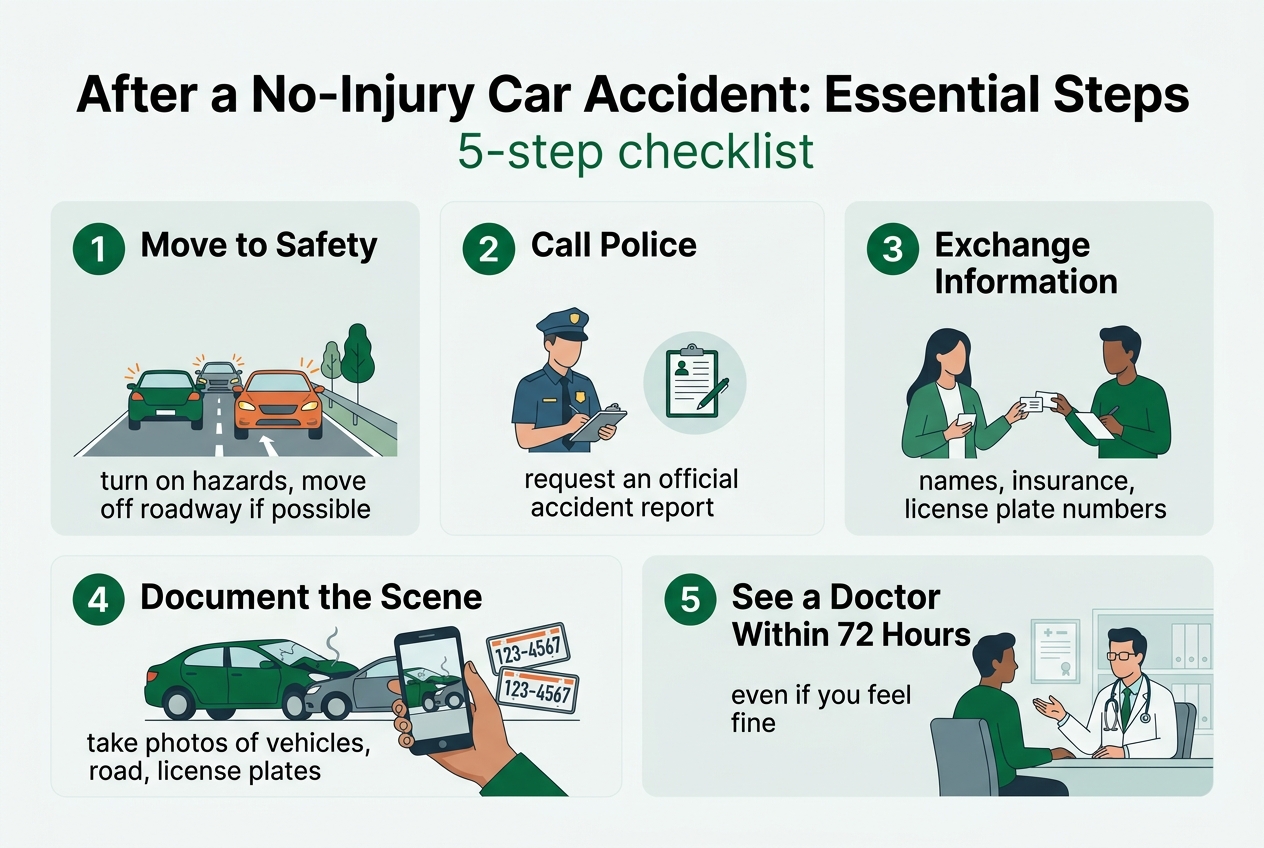
Think of documentation as insurance for your insurance claim. Memories fade, stories shift, and insurers love vague accounts. A thorough record made on the spot is hard to argue with later. Here’s what you should do, roughly in order:
- Check yourself and every passenger for pain, dizziness, tingling, or disorientation, since some of these signs point to injuries that haven’t fully surfaced yet.
- Move vehicles out of traffic if they’re drivable, both to stay safe and to avoid a second, worse collision.
- Call the police and request an official crash report, which becomes a key piece of evidence if injuries or disputes surface weeks later.
- Exchange full names, insurance policy numbers, and phone contacts with everyone involved, not just the other driver’s basic details.
- Photograph the scene from multiple angles, including vehicle damage, skid marks, traffic signs, and road or weather conditions at the time.
- Notify your own insurance company promptly, regardless of how you feel, since most policies require prompt reporting no matter the outcome.
Skip any of these, and you’re gambling with your own case. That’s the blunt truth. A missing photo or an unrecorded name can turn a simple claim into a drawn-out argument. If you’re weighing whether legal help is even necessary at this stage, it’s worth learning why a lawyer may still matter after a seemingly minor crash. Documentation now saves headaches later, plain and simple.

Injuries That Often Don’t Appear Until Later
Feeling fine right after a crash doesn’t mean you walked away clean. Adrenaline is a great masking agent. It floods your system, dulls pain signals, and convinces you nothing’s wrong — until it wears off a day or two later and reality sets in. That’s why so many accident victims sign off on a quick insurance settlement, only to end up in a doctor’s office a week later wondering what happened.
- Whiplash and other soft tissue injuries often don’t cause stiffness, headaches, or reduced range of motion until 24 to 72 hours after the impact.
- Concussions and mild traumatic brain injuries can hide behind normal-seeming behavior for days, and learning how doctors identify traumatic brain injuries caused by car accidents helps explain why they’re so easy to dismiss at first.
- Disc injuries and nerve damage tend to worsen gradually, starting as mild tingling or a dull ache before progressing into radiating pain or numbness weeks later.
- Internal bruising or bleeding sometimes shows zero external signs at first, which is exactly why unexplained abdominal pain or dizziness after a crash deserves urgent medical attention, not a wait-and-see attitude.
- Emotional and psychological trauma, including anxiety, sleep disruption, or full-blown PTSD, can surface weeks after the accident once the initial shock fades.
Here’s the blunt truth: your body doesn’t send an invoice for every injury on day one. Some bills come later, with interest. If any of these symptoms show up, even mildly, get evaluated. Delayed injury is still injury, and it deserves the same attention as a broken bone at the scene.
No Injuries at the Scene vs. Delayed Diagnosis: A Side-by-Side Look
Comparing Immediate Symptoms and Delayed Onset Cases
Two drivers walk away from the same fender-bender. One feels fine and stays fine. The other feels fine, then wakes up Tuesday with a stiff neck and a headache that won’t quit. Same crash, two very different paths. The table below lays out how each scenario typically plays out, from urgency to paperwork to how insurers respond.
| Factor | No Symptoms at Scene | Delayed Onset (Days Later) |
|---|---|---|
| Urgency of medical care | Low; self-monitor for 72 hours | High; see a doctor same-day once symptoms appear |
| Documentation needed | Police report, photos, witness names | All of the above, plus dated medical records tying symptoms to the crash |
| Insurance reporting | Report within 24-48 hours regardless | Same reporting window, then a supplemental notice once symptoms emerge |
| Claim timing | Often closed quickly, low value | Stays open longer; value tied to treatment records |
| Typical outcome | Property damage claim only | Possible injury claim requiring proof of causation |
Delayed diagnosis changes the whole conversation with an adjuster. It’s no longer just about a dented bumper. It’s about proving a headache or numbness actually traces back to the crash and not something else. That’s harder than it sounds. Timing and documentation become everything, and understanding how to prove a traumatic brain injury shows just how much medical evidence a delayed case can demand compared to one where symptoms show up immediately.
Do You Have to Report a No-Injury Accident in New Jersey
How Long You Have to File a Report After a Minor Crash
New Jersey law sets a clear line for when a crash becomes reportable. If the accident causes death, injury, or property damage that appears to total $500 or more, you’re required to report it to police. Given today’s repair costs, almost any fender bender clears that bar. So don’t assume a quiet, no-injury crash is automatically off the books.
Even when a report isn’t strictly mandatory, filing one is smart. A police report creates a neutral, timestamped record of what happened, who was involved, and what each driver said at the scene. That matters later, because memories fade and stories shift. If a dispute pops up weeks down the road, that report becomes your anchor. This is especially true in what’s technically called a NONINJURY Definition & Meaning crash, where there’s no ambulance run or ER chart to document that the collision even happened.
Practically speaking, call police to the scene right away if you can. If officers can’t respond and the crash is minor, most New Jersey municipalities let you file a report at the local station within a set window, often 10 days. Don’t wait that long, though. File it in the first day or two while details are fresh, especially if there’s any chance a truck or commercial vehicle was involved, since those cases carry different rules on when should you hire a truck accident lawyer to help sort out liability. Notifying your insurance company is a separate obligation from reporting to police, and most policies require prompt notice regardless of fault or injury. Skip it, and you risk a coverage fight later. That’s a headache nobody needs.
Can You File a Claim or Lawsuit Without Visible Injuries
Why an Attorney Review Still Makes Sense Before Signing a Release
Yes, you can file even when nobody got hurt. A property damage claim covers the car repairs, and it can also cover a rental while your vehicle sits in the shop. Lost wages count too, if you missed work dealing with tow trucks, estimates, or insurance calls. None of that requires a single bruise. People assume “no injury” means “no claim.” That’s just wrong.
Here’s the catch: once you sign a release, you’re done. That release usually closes out the entire claim, not just the property piece, so if pain shows up two weeks later, you may have already signed away your right to ask for more. This is exactly the trap covered in discussions of common mistakes that can ruin your personal injury case, and rushing to sign is near the top of that list.
A quick review before you sign costs you nothing in most cases, since injury attorneys typically don’t charge upfront for a consultation. Think of it as a second set of eyes checking for a trapdoor you can’t see.
How a Claim Can Be Amended if Symptoms Emerge Later
If you haven’t signed a release yet, an existing claim can usually be amended to add medical treatment once symptoms surface. This happens constantly with whiplash and soft-tissue injuries, which often take days to announce themselves. Your case doesn’t need to be refiled from scratch. It gets updated with new records, new bills, and a revised demand.
Timing still matters. New Jersey’s statute of limitations gives you two years from the accident date to file a personal injury lawsuit, but insurers move faster than that, and evidence fades. A resource explaining what is a no-injury accident versus a delayed-symptom case is worth understanding early, before you’re negotiating blind.
Addressing Common Insurer Pushback on ‘No Injury’ Claims
Adjusters love the phrase “no injury noted at the scene.” They’ll use it to argue the crash was too minor to cause harm, then offer a fast, low check for property damage only. It’s a standard playbook, not a personal judgment about your case.
Attorneys counter this with documentation: photos, repair estimates, medical records filed the moment symptoms appear, and sometimes an accident reconstruction expert if the impact severity is disputed. The goal is closing the gap between “looked fine” and “wasn’t fine.”
Why an Evaluation Still Matters Even in a No-Injury Case
Even if you feel completely fine, a short case review can flag risks you wouldn’t think to ask about. Property damage disputes, diminished vehicle value, or a liability disagreement can all turn a “simple” fender bender into a drawn-out fight. It costs little to find out where you actually stand.

Protecting Your Rights: Pros and Cons of Waiting to See a Doctor
Weighing Immediate Evaluation Against a Wait-and-See Approach
You feel fine. So why go to the doctor? Because feeling fine right after a crash means very little. Adrenaline masks pain for hours, sometimes days. A same-day or next-day exam creates a documented baseline, catches injuries that haven’t announced themselves yet, and gives any future claim solid medical footing instead of guesswork.
Waiting carries real costs, and they’re not just physical. The longer the gap between the crash and treatment, the easier it becomes for an insurer to argue something else caused your pain. Understanding how pre-existing conditions impact personal injury claims makes it obvious why timing matters so much to adjusters. Treatable strains can also turn into chronic problems when left alone.
Here’s a quick side-by-side of what each path typically means:
| Factor | Immediate Evaluation | Wait-and-See |
|---|---|---|
| Medical record timing | Documented within 24–72 hours | Days or weeks later, if at all |
| Causation strength | Strong link to the accident | Easier for insurers to dispute |
| Hidden injury detection | Caught early through imaging/exam | May surface only after symptoms worsen |
| Claim leverage | Solid documentation supports full value | Weaker evidence, lower settlement offers |
| Recovery outlook | Treatment starts promptly | Condition may progress untreated |
Think of this as a legal safeguard, not a doctor’s appointment you’re too tough for. Some general practices offer a similar early-injury screening; some urgent care clinics do too. Either works. What matters is timing, not the venue.
How Working With an Experienced Attorney Protects You Later
When It’s Worth a Free Consultation Even Without Obvious Injuries
Insurance adjusters aren’t neutral. They’re trained to close files fast and cheap. An attorney who’s worked the defense side or sat in a claims director’s chair knows the playbook before it’s dealt: the quick settlement offer, the recorded statement request, the polite call three days later asking “how are you feeling?” That question isn’t kindness. It’s evidence-gathering. A lawyer who’s seen it from the inside can spot the move and shut it down before it costs you anything.
That’s exactly why a free consultation matters even when you feel completely fine. You’re not committing to a lawsuit — you’re getting a second set of eyes on paperwork that’s easy to misread under stress. And you’re not the only one who benefits from knowing the ropes; reading up on what to do immediately after a car accident when no symptoms have shown up yet can help you avoid saying something an adjuster will later use against you.
No cost, no pressure, no obligation. If nothing develops, you’ve lost twenty minutes. If something does, you’ve already got a file started, a timeline, and a professional in your corner who anticipated this exact situation months before your neck started hurting.
Settlement numbers thrown out before an MRI or an orthopedic evaluation are guesses dressed up as offers. A responsible attorney won’t estimate a figure until medical experts weigh in — because soft tissue injuries, disc issues, and concussion symptoms often need imaging, specialist notes, and sometimes months of treatment history before anyone can put a real number on them.
This is where experience with catastrophic and complex injury claims pays off. Consulting orthopedists, neurologists, or physical therapists isn’t about padding a file. It’s about building a record that actually reflects what happened to your body, so the number on the table isn’t a lowball built on incomplete information.
Clients often worry they’ll be forgotten once paperwork is filed. That fear is common, and honestly, it’s earned — plenty of firms go quiet for weeks. Ongoing, personal updates on medical developments and case status change that dynamic, so you’re never left guessing whether your claim is moving or stalled.
Delayed symptoms don’t respect neat legal categories. A sore back from a fender-bender might turn into a workers’ comp question if you were driving for work, or a premises liability issue if road conditions or a poorly maintained lot played a role. Attorneys who handle motor vehicle, premises liability, and workplace injury cases together can pivot when new facts emerge — including situations where new jersey workers compensation rules intersect with an on-the-job crash.
That cross-practice familiarity matters because delayed diagnoses often blur the line between claim types. A single conversation can clarify which path applies, saving weeks of confusion later. It’s also why representation across Passaic, Bergen, Hudson, Essex, and neighboring counties matters. Local courts, local insurers, and local medical providers all have patterns worth knowing, and an attorney familiar with the region’s hospitals, imaging centers, and claims offices can move your case forward without the learning curve costing you time.
Even when an accident leaves you without visible injuries, it’s worth having a conversation with someone who knows how insurance companies evaluate these claims. The team at Weiner Mazzei, led by former insurance Claims Director Franco Mazzei, has spent decades helping accident victims throughout northern New Jersey understand their options. Stop by their longtime office at 165 Prospect St. in Passaic or call 973-471-2300 to talk through your situation and find out where you stand.