
Someone’s spreading lies about you, and it’s costing you real money or your good name — so you start searching for a defamation lawyer to fight back. That’s a real legal path, but it’s not what you’ll find at Weiner Mazzei. If your damage came from a crash, a fall, or an injury on someone else’s property instead of someone’s words, our personal injury, premises liability, and workers’ compensation teams in northern New Jersey are built for that fight.
What a Defamation Lawyer Actually Handles
Libel vs. slander basics
Defamation splits into two categories. The difference matters. Libel covers written or published falsehoods — a social media post, a blog comment, a bad-faith review. Slander covers spoken statements that damage someone’s reputation, like a false accusation made at a meeting or shouted across a parking lot. Both require proof the statement was false, that it reached a third party, and that it caused real harm to a person’s name or business.
That’s a narrow, specific kind of case. It’s not about who yelled loudest or who felt most insulted. A lawyer handling this type of claim has to dig into publication records, witness statements, and sometimes expert testimony on reputational or financial loss. Many local businesses deal with online reviews that sting, but not every harsh comment rises to legal defamation. Opinion is protected speech, and that trips up a lot of people who think they have a case.
How defamation claims differ from injury claims
Here’s the blunt version: one type of case is about words, the other is about bodies. Defamation disputes live in civil court alongside contract fights and business torts. They don’t involve broken bones, medical bills, or lost wages from missing work after a crash. A personal injury claim, by contrast, centers on physical harm — what happened, who caused it, and what it cost the victim in treatment and recovery.
A defamation lawyer evaluates falsity, publication, and reputational damages. A personal injury attorney evaluates fault, medical documentation, and physical losses. That’s a completely different set of evidence and strategy. If you were hurt in a crash and want to understand how injuries show up days later, resources explaining common whiplash symptoms after a collision are far more useful than anything about libel law.
This distinction is why a firm focused on physical injury and workplace injury claims doesn’t dabble in defamation. The legal theories, the courts, and the proof requirements don’t overlap much. If your situation involves a car accident, a workplace injury, a slip and fall, or a defective product, that’s a different lane entirely — and one where finding the right personal injury representation actually applies. Reputation harm and bodily harm just aren’t the same fight.

Why People Search for a Defamation Lawyer After an Accident or Injury
When reputation harm overlaps with an injury dispute
It happens more than you’d think. Someone gets hurt in a crash or a fall, files a claim, and then an insurer or employer starts saying things that feel personal — that the injury isn’t real, that the claim is exaggerated, that the person can’t be trusted. Stung and angry, they type “defamation lawyer” into a search bar. That’s understandable. But it’s often the wrong legal category for what actually happened.
Here’s the distinction that matters. Defamation requires a false statement of fact, published to someone else, that damages your reputation. An adjuster telling you privately that your claim “seems inflated” doesn’t meet that bar, even if it stings like an insult. It’s a claims-handling dispute, not a reputational attack. Confusing the two can send you down the wrong legal path for months. Some of these situations are genuinely close calls where common mistakes that can derail a case start right at this misidentification stage.
So before you search for reputation-focused counsel, ask what actually caused the harm. Was it a statement made to third parties that damaged your standing in the community? Or was it an insurer being difficult about your claim? Most of the time, it’s the latter. That’s a different fight entirely.
Why fraud accusations usually aren’t defamation
Adjusters accuse claimants of fraud more often than people realize. It’s a tactic, frankly, meant to pressure you into settling cheap or walking away. When it happens to you, it feels like slander. Someone’s questioning your honesty, maybe even suggesting it to a supervisor or a file note. But accusations made during the claims process, even unfair ones, typically fall under bad-faith insurance practices, not defamation law.
Bad-faith handling covers things like unreasonable delays, lowball offers without justification, or denying a claim without proper investigation. It’s a real problem with real remedies, just not the ones a defamation case offers. Pursuing the wrong legal theory wastes time you don’t have, especially with medical bills piling up. Many injury victims never even see the file notes where these accusations live. That’s part of why having representation who knows what insurers write down — and why — matters so much; finding the right car accident attorney often resolves this frustration faster than chasing a defamation angle ever would.
Getting the right representation for the actual problem
If your core issue is a car accident, a workplace injury, or a fall on someone else’s property, you need a personal injury or workers’ compensation attorney — not a defamation specialist. That’s not a technicality. It determines which laws apply, which deadlines matter, and who you’re actually up against.
This is where knowing how the other side thinks pays off. An attorney who once sat on the insurance side of the table — reviewing files, authorizing settlements, deciding when to fight a claim — brings a different kind of insight to disputing injury cases. They’ve seen the fraud-accusation playbook from the inside. They know when it’s a genuine liability question and when it’s just pressure meant to make you fold. That experience shapes negotiation strategy from day one, not as an afterthought once things go sideways.

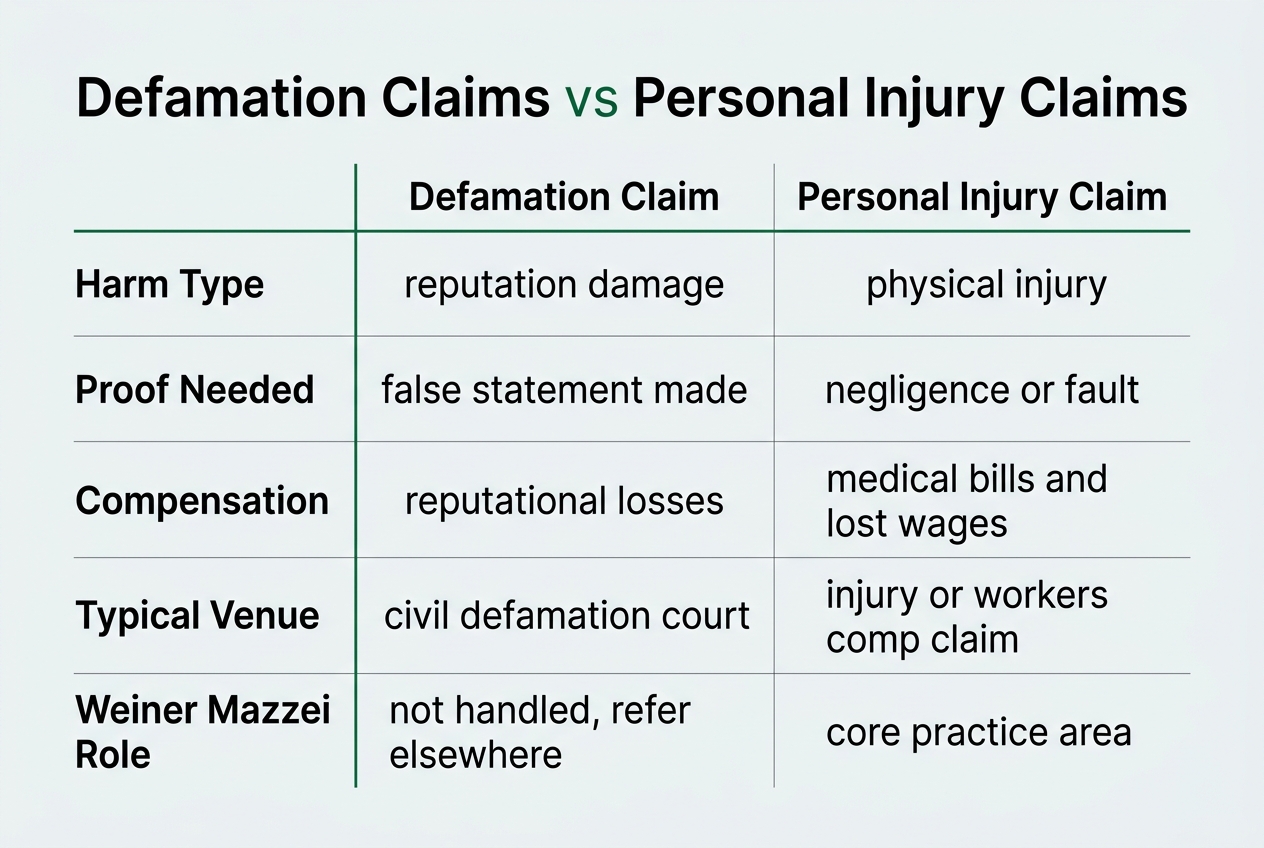
Defamation Claims vs. Personal Injury Claims: Key Differences
These two types of cases get mixed up more than you’d think. Someone’s reputation takes a hit online, and they wonder if it’s the same legal process as a car crash claim. It isn’t. The legal basis, the proof required, and even the courtroom can differ. Here’s a side-by-side look at how they actually compare.
| Factor | Defamation Claim | Personal Injury Claim |
|---|---|---|
| Legal basis | False statement of fact causing reputational harm | Negligence or wrongdoing causing physical or emotional harm |
| Core proof needed | Statement was false, published, and damaging | Duty, breach, causation, and documented medical damages |
| Typical damages | Lost business, harm to reputation, emotional distress | Medical bills, lost wages, pain and suffering |
| Common defendants | Individuals, media outlets, online reviewers, competitors | Drivers, property owners, employers, manufacturers |
| Filing timeline | Often one year from the statement in New Jersey | Generally two years from the injury date |
Notice the proof standard alone. A defamation case lives and dies on whether a statement was false and actually published to someone else. A personal injury case lives and dies on medical records, accident reports, and expert testimony tying an injury to someone’s carelessness. That’s a different kind of evidence file entirely. If you were hurt in a crash, for instance, meeting New Jersey’s injury threshold matters far more than anything resembling reputational harm.
Different proof, often different courts, and usually different attorneys. Someone who handles business reputation disputes typically isn’t the same lawyer you’d call after a slip and fall or a workplace accident. Complex injury cases, especially ones involving brain trauma, also demand medical documentation that defamation claims never touch; building a traumatic brain injury claim looks nothing like building a reputation case.
Situations That Call for a Different Kind of Attorney
Injury-adjacent legal needs outside personal injury law
Not every injury claim fits neatly into one box. Some situations sound like personal injury cases but actually need a different specialist entirely. Knowing the difference now saves you weeks of chasing the wrong attorney later. Here’s where the lines usually blur, and where they don’t.
- Medical malpractice claims, where negligent treatment itself caused the harm, require a dedicated med-mal firm with its own set of experts; but if your injury happened in a car crash, at your job, or on someone else’s unsafe property, that’s standard personal injury, workers’ comp, or premises liability territory instead.
- Wrongful death cases involving a family’s catastrophic loss carry their own legal requirements and deadlines, so those should be confirmed directly with a firm; catastrophic loss and motor vehicle or truck accident representation often covers the related severe-outcome claims that arise from the same event.
- Social Security Disability is a federal benefits program with its own application process, separate from state-level claims; an injured worker who can’t return to the job should look toward workers’ compensation benefits, not federal SSD representation, as the first avenue for recovery.
- Criminal defense, including DUI charges against the driver who hit you, is handled by a criminal attorney in a separate courtroom entirely; your civil claim for compensation runs on its own track, and that’s exactly what motor vehicle accident representation is built to pursue.
Here’s the blunt truth: mixing these up wastes real time. A malpractice case filed as a slip-and-fall gets nowhere fast. If you’re building a car accident claim, understanding when to hire a personal injury attorney for car accident situations helps you act before deadlines close in. And if you’re still mapping out the filing process itself, reviewing how to file a personal injury claim in New Jersey is a reasonable next step before you call anyone.
How to Choose the Right Attorney for Your Situation
Before you call anyone, figure out what kind of harm you actually suffered. Is it damage to your reputation, your body, or your bank account? A nasty online review is a different animal than a broken leg from a fall at work. Reputation harm usually needs a defamation attorney who understands libel and slander law. Physical injury from a car crash, a workplace accident, or a fall on someone’s property calls for a personal injury or workers’ compensation lawyer instead. Mixing these up wastes time and, sometimes, a filing deadline.
Questions to ask during a consultation
Not every lawyer who takes your call is the right fit. Some straightforward questions, asked plainly, will tell you a lot fast.
- Ask how many cases like yours the attorney has actually handled, not just how many years they’ve practiced overall.
- Find out whether the firm will work your case directly or simply refer it out to someone else once you sign.
- Get the fee structure in writing, including what happens to costs if the case doesn’t win.
- Ask how often you’ll hear updates, and from whom, since a paralegal isn’t the same as your actual lawyer.
- Confirm the firm covers your county and can meet in person, not just by phone or email.
- If your injury involved a large commercial vehicle, ask specifically about experience with those claims; reading up on how to choose the right truck accident lawyer beforehand helps you spot a well-prepared answer.
Red flags that signal a mismatch
Some warning signs show up before you even sign anything. A lawyer who guesses at your settlement value in the first five minutes is selling, not advising. So is one who won’t name specific past outcomes. Watch for vague answers about who actually handles your file day to day, and firms that dodge direct questions about county coverage or in-person availability. If you were hurt in a vehicle collision, it’s worth comparing notes against general guidance on car accident claims so you know what thorough representation should look like. Trust your gut here. If something feels rushed or scripted, it probably is.
What Sets Weiner Mazzei Apart for Personal Injury and Workers’ Comp Claims
Experience built from both sides of the claims table.
Thirty-plus years is a long time to be in one corner of the law. That’s how long this team has spent representing injury victims across northern New Jersey, through cases big and small, routine and catastrophic. You build instincts over that stretch of time. You also build a track record clients can actually check before they sign anything, which matters more than most people realize when they’re hurt, scared, and picking a lawyer fast.
Here’s the part that really separates this firm: the lead attorney used to sit on the other side. Franco Mazzei worked as a personal injury defense lawyer and later as an insurance company Claims Director before switching sides for good. That means he’s seen the playbook insurers use to delay, minimize, and deny claims — from the inside. He knows which arguments are theater and which ones actually hold up. Andrew De Avila and W. Joseph Weiner round out a team that brings similar depth, splitting their focus across motor vehicle cases, premises liability, and workers’ compensation so clients aren’t getting a generalist guessing at strategy.
Rather than eyeballing what a case might be worth, the firm consults outside experts — medical specialists, vocational analysts, accident reconstructionists — to document damages properly. That groundwork tends to produce stronger settlement positions than rough estimates ever could. Clients also get regular updates on case and medical developments, so nobody’s left wondering if their file is sitting in a drawer somewhere. If you’re still comparing options, it’s worth reading through practical factors for choosing a personal injury attorney before committing to one. The firm’s caseload spans car accidents, truck crashes, premises liability, slip and falls, product liability, catastrophic injury, and workers’ compensation — handled from the same office at 165 Prospect St. in Passaic since the 1970s, serving Passaic, Bergen, Hudson, Essex, Middlesex, Mercer, Morris, Monmouth, Somerset, and Hunterdon counties.
Steps to Take If You’re Unsure Which Attorney You Need
Not sure if your situation needs a reputation claim or a straightforward injury case? Start small. Before you dial anyone, run through a quick mental checklist. It takes five minutes and saves you from calling the wrong office three times.
A simple self-assessment checklist
Write down exactly what happened and when, including any statements made about you by another party. Then separate the two threads: the physical injury facts on one side, the reputation-damaging statements on the other. These often get tangled together after a crash or workplace incident, but they’re legally distinct problems. A torn ligament is not the same claim as a false comment about how it happened. Keep them apart from the start.
| Situation | Primary Harm | Who to Call First |
|---|---|---|
| Car or truck crash with injury | Physical harm, lost wages | Personal injury / motor vehicle attorney |
| Fall on unsafe property | Physical harm | Premises liability attorney |
| Injury on the job | Medical costs, missed work | Workers’ compensation attorney |
| False statements about your character | Reputation damage | Defamation attorney |
| Defective product caused harm | Physical harm, property damage | Product liability attorney |
Documents to gather before your first call
Pull together accident reports, medical records, witness names, and any correspondence tied to the incident. If a truck was involved, understanding what to do after a semi truck accident can help you figure out which records matter most. Then call a firm that matches your primary harm, and ask directly whether they handle it or can point you elsewhere. Honesty up front saves everyone time. For crash, workplace, premises, or product injury claims specifically, reach a firm at 973-471-2300 and describe what happened in plain terms. A short phone call usually sorts out more than an hour of searching online.
Deciding how to move forward after a serious injury usually comes down to a few honest questions: how clear is the cause, how long will recovery take, and who else might share responsibility for what happened. Those answers shape whether a claim fits squarely within personal injury, workers’ compensation, or premises liability, or whether it calls for a different kind of specialist entirely. Taking stock of the facts first, rather than the label attached to them, tends to make the next step clearer.