
You’re sitting in a deposition or courtroom, and suddenly your attorney raises a lack of foundation objection to stop testimony or evidence in its tracks. It sounds technical. But it can shape the outcome of your personal injury case in ways you might not expect. If you’re pursuing a car accident, workers’ compensation, or premises liability claim in New Jersey, understanding this objection helps you see why your legal team fights so hard over what gets admitted into evidence.
What Does a Lack of Foundation Objection Mean in Court
Foundation vs. relevance objections
A foundation objection challenges the setup, not the substance. It says: you haven’t shown me this witness or exhibit is what you claim it is. Before a jury or claims adjuster ever weighs the actual content of testimony or a document, the person offering it has to establish who’s speaking, what the item is, when it was created, and where it came from. Skip that groundwork, and opposing counsel can stop the testimony cold with a single word: “objection.”
Relevance is a different animal entirely. A relevance objection argues the evidence doesn’t matter to the case, even if it’s perfectly legitimate. Foundation, by contrast, doesn’t dispute that a photo or a medical record could matter. It disputes whether anyone has proven it’s genuine, accurate, or connected to the events at hand. Personal knowledge overlaps here too — a witness needs to show they actually saw or experienced what they’re describing, not just heard about it secondhand.
Mixing these up is a common mistake, even among people who’ve sat through a few depositions. A photo can be wildly relevant to an accident and still get tossed if nobody can say who took it or when. That’s the blunt truth about foundation: relevance gets you in the door, foundation is the doorman checking your ID.
Where foundation issues typically arise in injury cases
Photographs cause the most trouble. Someone snaps a picture of a cracked sidewalk weeks after a fall, and without testimony establishing when it was taken and whether the scene had changed, that photo can get excluded. The same goes for medical records pulled from a file without a records custodian or treating provider confirming they’re authentic and complete. Surveillance footage from a store or parking lot faces similar scrutiny — someone has to explain how the camera works, who retrieved the footage, and whether it’s unedited.
Expert testimony runs into foundation objections constantly, particularly around qualifications. An expert opining on long-term injury costs needs to show their credentials and methodology before the substance of their opinion counts for anything, which is why firms handling catastrophic loss claims often lean on outside specialists to document damages properly rather than guessing at numbers. Witness statements about vehicle speed or property conditions face the same test: did they actually see it, or are they repeating what someone else told them?
This rule exists for a simple reason. Courts don’t want juries — or insurance adjusters, for that matter — swayed by evidence nobody’s verified. If you’re comparing attorneys to handle a claim like this, reviewing things to consider when choosing a personal injury attorney can help you spot who actually knows how to build an admissible record. Unverified evidence is just noise dressed up as proof, and the rule’s job is to filter it out before it does damage.
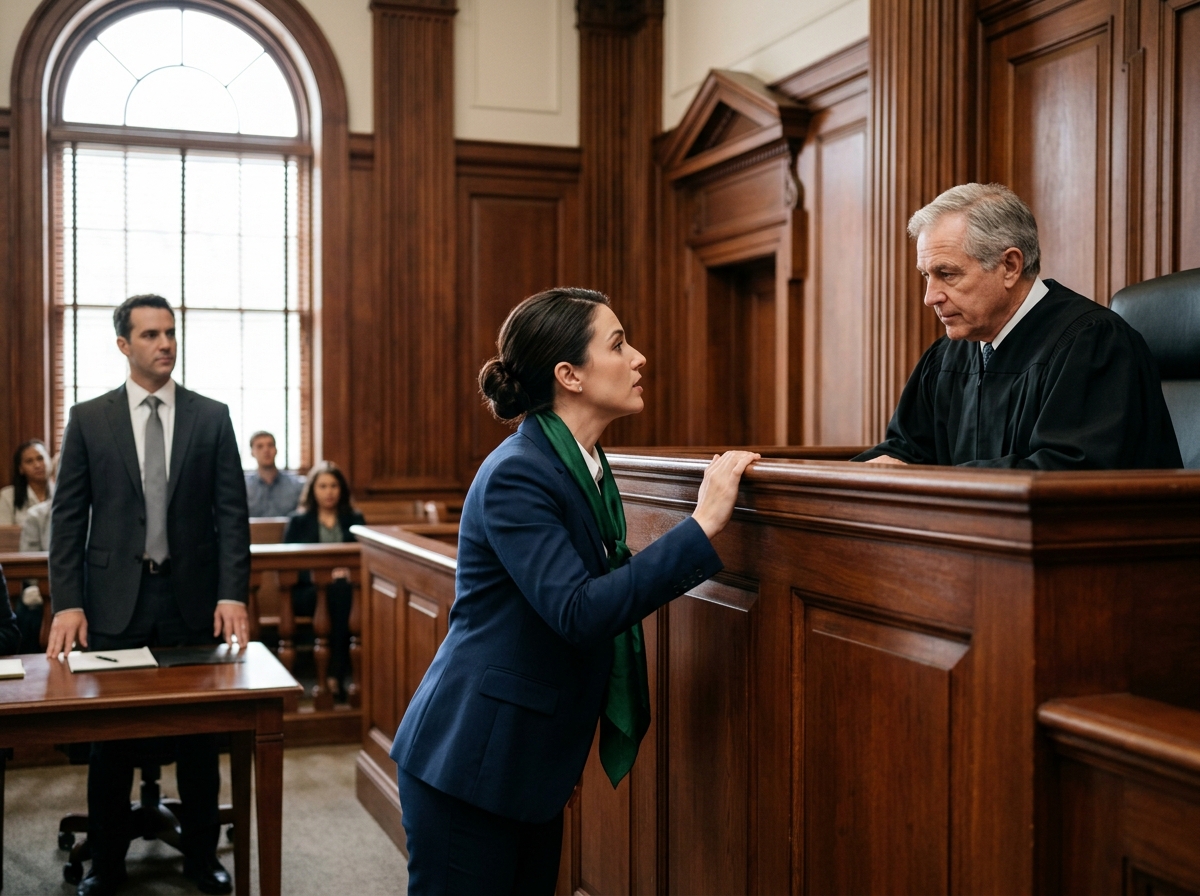
How a Lack of Foundation Objection Plays Out in a Personal Injury Claim
Common foundation gaps in accident evidence
Foundation problems can crop up almost anywhere in an injury case file. Medical records, accident scene photos, expert opinions, and witness statements all share one requirement: someone has to establish where they came from and why they’re reliable before a judge lets a jury see them. Skip that step, and even the most compelling piece of proof can get tossed aside without ever being weighed on the merits. It’s a technical rule with very real consequences.
Insurance defense attorneys know this rule well, and they use it. Raising a foundation objection is one of the cheapest, fastest ways to keep damaging evidence away from a jury or an adjuster reviewing your file. Consider a photo showing a cracked stairway or a puddle near a store entrance. It looks damning, until opposing counsel points out that nobody testified to when it was taken, where exactly it was shot, or whether conditions had changed by the time the photographer arrived. If you’re weighing when to hire a personal injury attorney for car accident matters, this is exactly the kind of pitfall that makes early legal help worthwhile.
Medical bills face the same scrutiny. A stack of invoices means little if no custodian of records or treating provider shows up to confirm they’re authentic and tied to your treatment. Same goes for expert opinions built on data nobody verified, or witness statements offered secondhand instead of from the person who saw the event. And here’s the blunt truth: a sustained objection doesn’t just weaken your case, it erases that evidence entirely. The jury never sees it, the adjuster never factors it in, and no amount of arguing afterward brings it back. That single gap can be the difference between full compensation and a lowball settlement offer, a risk noted even in unrelated fields like property damage claim disputes where documentation gaps sink otherwise strong claims.

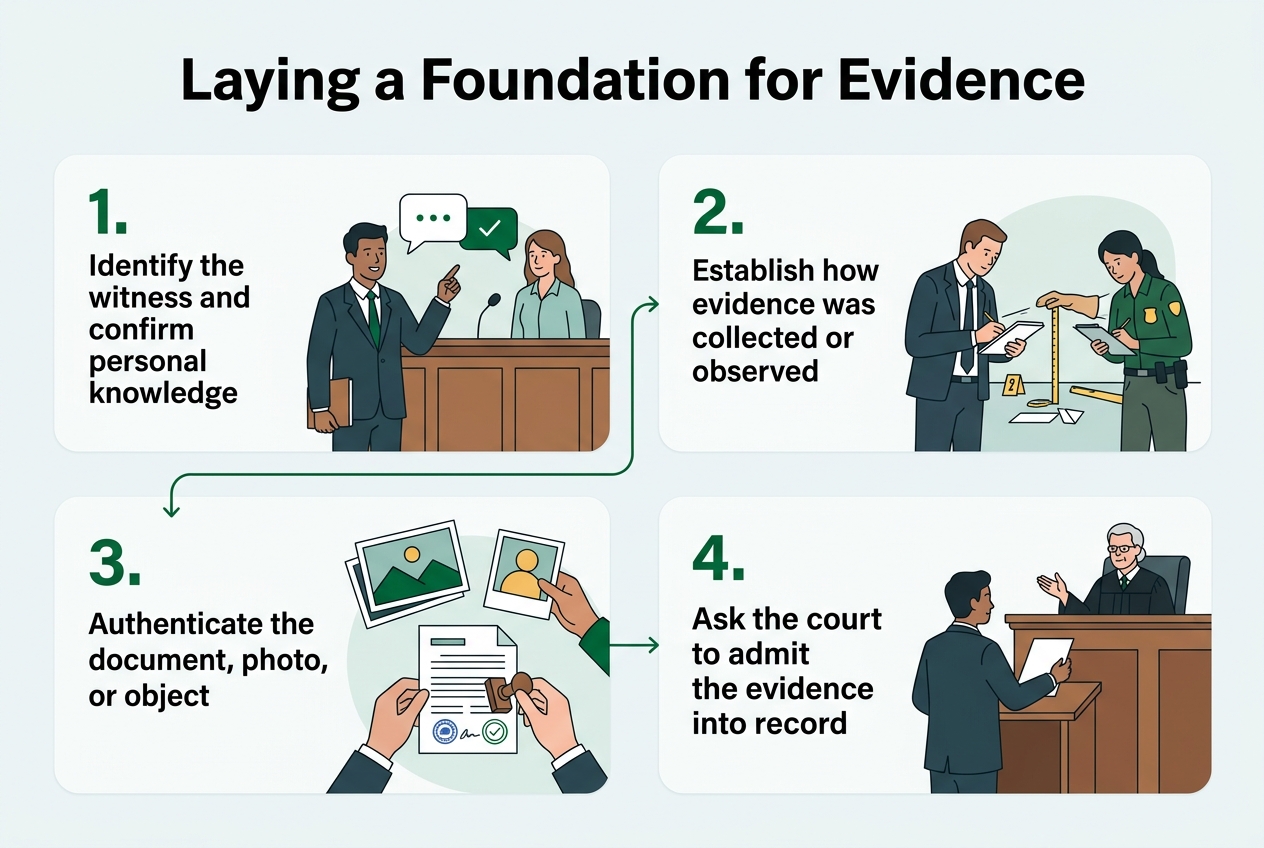
Steps to Properly Lay a Foundation for Evidence
Laying a proper foundation isn’t one big move. It’s a sequence, and skipping a step is what invites an objection in the first place. Attorneys usually walk through the same basic sequence no matter what the evidence is — a photo, a medical record, an expert opinion, a piece of physical property from the accident scene. Get the order wrong, and even solid evidence can get tossed out or picked apart on the spot.
| Step | Purpose | Example |
|---|---|---|
| Identify the witness’s basis of knowledge | Shows the witness actually saw or handled what they’re testifying about | “Where were you standing when the forklift tipped over?” |
| Establish chain of custody | Proves the item hasn’t been altered or swapped | Tracking a torn safety harness from the job site to the evidence locker |
| Connect evidence to time and place | Ties the exhibit to the actual incident, not a similar one | Dating a surveillance clip to the exact hour of a slip and fall |
| Confirm expert qualifications | Establishes credibility before opinions are heard | Reviewing a biomechanical expert’s training and prior case history |
| Ask preliminary questions first | Builds the record step by step before the key point | Confirming a doctor treated the patient before asking about the diagnosis |
Notice the pattern: each step feeds the next. You can’t jump to an expert’s conclusion without confirming credentials first. You can’t ask a witness what a document says without confirming they wrote it or reviewed it. Truck crash cases often need extra layers here, since data logs and inspection records each need their own foundation; learning what to do after a semi truck accident shows why documentation gets complicated fast. Miss a step, and the whole exhibit can get struck. That’s not a technicality — it’s the rule working exactly as intended.
Objections Based on the Form of the Question vs. Foundation Objections
Not every objection you hear in a deposition or at trial has anything to do with missing proof. Attorneys object to how a question is asked far more often than they object to whether it’s backed up by evidence. Knowing which is which helps you follow what’s actually happening in your case instead of assuming every objection means something got derailed.
Where the categories overlap
Vague, compound, leading, argumentative, and asked-and-answered questions are all objections to the form of the question. They’re about sentence structure, not about whether the witness has a basis to answer. A foundation objection is different: it says the lawyer hasn’t yet shown the witness knows what they’re talking about, or that a document is what it claims to be. Two objections that sound similar can attack completely different problems, and that’s exactly where readers following their own hearings get confused.
| Objection Type | What It Targets | Fix Needed |
|---|---|---|
| Vague or ambiguous | Confusing wording | Rephrase the question |
| Leading | Suggests the answer | Ask open-ended instead |
| Asked and answered | Repetition | Move to a new topic |
| Lack of foundation | Missing evidentiary predicate | Establish witness knowledge or document authenticity first |
| Assumes facts not in evidence | Unproven premise baked into the question | Prove the fact before referencing it |
Two objections sit in a gray zone. Misquoting a witness and assuming facts not in evidence both touch on wording, but they also expose a foundation gap, since the question presumes something the record hasn’t established yet. Grasping this distinction matters if you’re sitting through your own hearings and trying to gauge whether an objection is a minor speed bump or a real threat to a piece of evidence; why understanding the court process matters becomes obvious the first time a ruling changes what the jury gets to hear.
Other Common Evidentiary Objections Injury Victims Should Recognize
A foundation objection isn’t the only one you’ll hear during a deposition or trial. Several other objections show up constantly in personal injury cases, and knowing what they mean will help you follow along instead of feeling lost. Most of them boil down to a simple question: is this piece of testimony actually reliable enough for a judge or jury to consider?
Here are the objections you’re most likely to run into, and what each one really targets:
- Hearsay comes up when a witness repeats something someone else said outside the courtroom, and it’s being offered to prove that statement was true.
- Lack of personal knowledge applies when a witness starts describing things they didn’t actually see or experience firsthand, like guessing at vehicle speed from a secondhand account.
- Relevance objections argue that a piece of evidence has nothing to do with the facts the case actually turns on.
- Speculation gets raised when a witness is asked to guess at something rather than state what they actually know.
- Leading questions during direct examination can also draw objections, since attorneys aren’t supposed to feed a witness the answer they want.
These distinctions matter more than they might seem. A defense attorney who objects to speculation isn’t just being difficult — they’re trying to keep guesswork out of the record entirely. That’s their job. Understanding these categories also helps you spot when a case is being built on shaky testimony versus solid, admissible fact. If you’re building a claim after a crash, reviewing how car accident claims typically proceed can give you a clearer sense of where these objections tend to surface. It’s also worth learning about common mistakes that can ruin your personal injury case, since weak or objectionable testimony is often part of the problem.
Why Foundation Objections Matter More in Certain Injury Cases
Why experienced counsel anticipates these challenges early
Not every case carries the same evidentiary risk. Some injury claims rest almost entirely on technical records, digital data, or third-party documentation that opposing counsel can pick apart if it isn’t introduced correctly. A photo taken by a bystander is one thing. A truck’s electronic control module readout is another entirely. Understanding basic foundation for the admission of evidence matters in every case, but in some it can decide the outcome outright.
Truck accident cases lean heavily on black box data, maintenance logs, and driver hours-of-service records. That data doesn’t speak for itself in court. Someone has to explain how it was extracted, who maintained it, and whether it was altered. Reading up on the importance of black box data in truck accident investigations shows just how technical this authentication process can get, and how easily an unprepared party can lose that evidence entirely.
Product liability claims depend on manufacturing records and defect testing results, often produced by a company with every incentive to keep them out. A broken chain of custody on a single test report can sink months of preparation. Premises liability and slip and fall cases hinge on surveillance footage and incident reports; whoever pulled the video needs to testify to how it was stored and whether it’s unedited. Workers’ compensation claims need a witness, usually a doctor or evaluator, to properly ground medical findings. And catastrophic injury claims involving decades of future care costs live or die on expert foundation. No judge accepts a $2 million life-care projection on a lawyer’s say-so. It needs a qualified voice behind every number.
How Skilled Legal Representation Handles Foundation Challenges
When to consult an attorney about evidentiary issues in your claim
If you’ve never sat across from an insurance company’s lawyer, you might not realize how often foundation objections get used as a delay tactic. Attorneys who spent years on the defense side, or worked inside a claims department, know the playbook cold. They’ve raised these objections themselves, on behalf of insurers, so they can spot exactly when opposing counsel is about to try the same move against you. That kind of experience changes how a case gets built from day one.
Good representation doesn’t wait for a challenge to happen. It builds a well-documented case from the start, so there’s less to attack later. That means gathering medical records the right way, securing accident scene photos with proper chain of custody, and keeping witness statements organized and dated. In fact, medical documentation for car accident compensation often becomes the single most contested category of evidence in a claim, so getting it right early matters.
Outside experts play a role too. Accident reconstructionists, medical specialists, and product engineers can authenticate evidence in ways a general practitioner simply can’t. When an expert testifies about how a part failed or how an injury occurred, that testimony needs its own foundation — credentials, methodology, reliability. Skilled counsel lines this up well before trial, not the week before.
Clients also deserve to know what’s happening with their case. Constant updates on medical developments and evidentiary strategy aren’t just nice extras — they help you understand why certain documents are being collected and how they’ll hold up. For crash, workplace, or premises injuries, dedicated personal injury, workers’ compensation, premises liability, and product liability representation helps present evidence that’s actually admissible, not just persuasive on paper. It’s a small distinction with a big courtroom impact.
One caveat worth stating plainly: not every injury scenario fits neatly into these categories. Claims involving alleged medical negligence, wrongful death, or other specialized matters fall outside standard personal injury practice areas and should be confirmed directly with the firm or a specialized attorney. Guessing at jurisdiction or scope here helps no one — ask first.
A lack of foundation objection can feel like a small technicality, but it often shapes what a jury is allowed to hear and how convincing a case ultimately becomes, so understanding the reasoning behind it is worth the effort. For those dealing with an injury claim stemming from a car accident, workplace incident, or unsafe property, knowing how evidence gets challenged and admitted can make the process feel less unpredictable, and firms like Weiner Mazzei that focus on personal injury representation understand how these evidentiary details connect to a client’s larger goals. Getting familiar with the basics now means fewer surprises later, whether the case is headed toward negotiation or trial.