
A motorcycle crash on Route 46 or the Garden State Parkway can leave you with mounting medical bills, a totaled bike, and an insurance adjuster who doesn’t take your injuries seriously. You deserve straight answers, not runaround. Northern New Jersey riders searching for motorcycle personal injury lawyers in 2026 need to understand how catastrophic loss and motor vehicle accident claims actually work before they sign anything. This article breaks down what to expect, and why confirming your specific case details directly with a firm like Weiner Mazzei at 973-471-2300 matters from day one.
What to Do Immediately After a Motorcycle Crash in New Jersey
At the Scene
The minutes right after a crash matter more than most riders realize. Adrenaline hides pain. You might feel fine and still have a fractured wrist or internal bleeding that won’t show symptoms for hours. That’s why the first call always has to be 911, even for what seems like a minor spill.
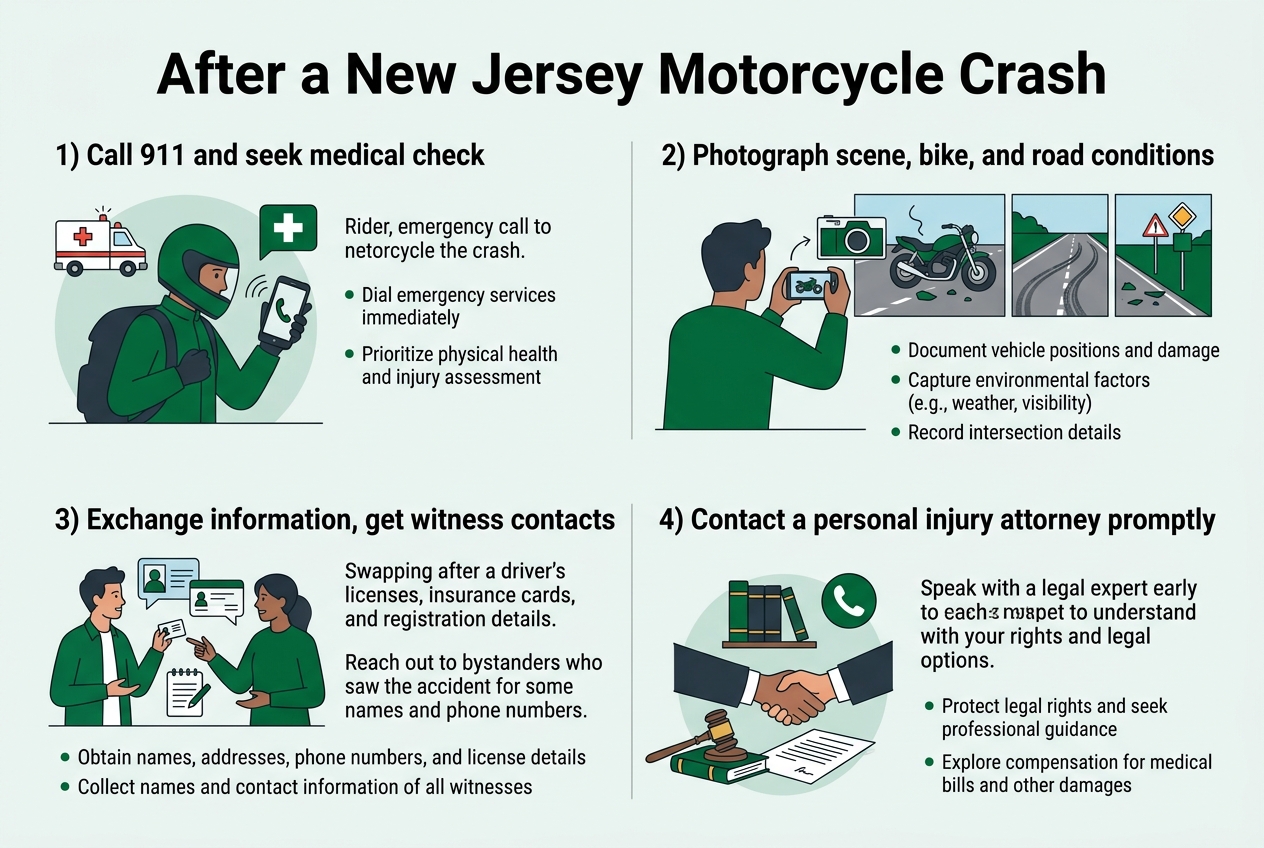
- Call 911 immediately and request both police and medical response, since a written police report becomes a key piece of evidence later.
- Get a full medical evaluation at the scene or the ER, even if you feel capable of walking away under your own power.
- Photograph the bike, your gear, skid marks, road conditions, and any visible injuries before anything gets moved or cleaned up.
- Collect names and phone numbers from witnesses who saw the crash happen, not just the other driver.
- Exchange insurance information with the other driver, including policy number and the name on the policy, not just a phone snapshot of their card.
Don’t rely on memory. Write it down or record a voice memo while details are still fresh.
In the Days That Follow
Once the dust settles, insurance adjusters tend to move fast, often faster than you’d expect. Many will call within a day or two asking for a recorded statement. Be careful here: anything you say can be used to shrink your claim later. It’s worth reviewing things to consider when choosing a personal injury attorney before you agree to speak with anyone representing the other side. Hold off on giving a statement until you’ve talked to someone who understands how these calls are used against riders.
Keep the motorcycle and your damaged gear exactly as they are. Don’t repair, donate, or toss anything, since a helmet crack or torn jacket can prove impact speed and force. Follow up with your own doctor within a few days of the ER visit, too; some injuries, including symptoms of whiplash, take time to surface. Skipping that follow-up gives insurers an easy excuse to question whether you were really hurt.
Motorcycle Personal Injury Lawyers: Who Handles These Claims and Why It Matters
Here’s something a lot of riders don’t realize: there’s no special license category called “motorcycle lawyer.” Motorcycle crash claims fall under the same personal injury and motor vehicle accident law that covers car wrecks, truck collisions, and other roadway cases. What changes isn’t the legal framework — it’s the facts. Riders face harder impacts, fewer protections, and insurers who often assume fault before they’ve even looked at the scene. A firm built on car accident, truck accident, and catastrophic injury claims can absolutely apply that same experience to a motorcycle case. Still, it’s worth confirming the specifics with a quick call rather than guessing.
That bias against riders is real, and it’s not new. Insurance adjusters are trained to look for reasons a motorcyclist contributed to his own injuries — speed, lane position, visibility — even when the facts don’t support it. Having an attorney who once sat on the other side of that table matters. A lead attorney with a background as a former defense lawyer and insurance company Claims Director has seen those tactics from the inside. That history helps in anticipating how a claim will be evaluated and in pushing back before a lowball offer becomes the final word. Reviewing common mistakes that can ruin your personal injury case is a smart step before signing anything an insurer sends over.
Geography matters too. A practice serving Passaic, Bergen, Hudson, Essex, Middlesex, Mercer, Morris, Monmouth, and Somerset counties since the 1970s has watched local roads, local courts, and local insurance patterns for decades. That’s not a small thing. For a sense of how experience translates into results, it helps to compare notes on what makes a strong motor vehicle attorney in New Jersey. Riders should still confirm, directly and specifically, how a motorcycle case fits into that firm’s motor vehicle and catastrophic loss work — a phone call settles it fast.
Do You Actually Need a Lawyer for a Motorcycle Accident?
Not every crash needs a lawyer. If it’s a minor parking-lot scrape, no injuries, and both sides agree on fault, you can often sort out the property damage yourself and move on. But that’s the exception, not the rule. Once an injury enters the picture, or fault gets murky, or the other driver has no insurance, you’re in different territory entirely. Those cases have moving parts most riders have never dealt with before, and guessing your way through them tends to cost more than it saves.
Here’s the uncomfortable truth: insurance adjusters often lowball motorcycle claims because of lingering bias against riders, treating them as reckless by default even when the facts say otherwise. That bias shows up in early settlement offers, which is why so many riders wonder should they get a lawyer for a motorcycle accident before signing anything. An attorney’s letterhead on a file changes the tone of negotiations almost immediately; adjusters know a represented claimant won’t accept a number pulled out of thin air.
So the real question isn’t how bad the crash looked. It’s what the claim is actually worth. A broken wrist with six months of lost wages and ongoing treatment is a different animal than a bruise and a bent fender. Case value should guide the decision to consult someone, not the drama of the accident scene itself.
Contingency Fees and Costs: What Hiring a Lawyer Really Costs
Here’s the good news: you shouldn’t have to pay anything out of pocket to hire a lawyer after a motorcycle crash. Most personal injury firms work on contingency, meaning the attorney only gets paid if you win. No retainer, no hourly billing, no invoice showing up while you’re still in a cast. The fee comes out of the settlement or verdict, so your lawyer’s interests are tied directly to getting you the biggest recovery possible.
That said, “contingency” isn’t a flat rate everywhere, and the percentage can shift depending on when your case resolves. The table below shows a typical structure you might encounter.
| Case Stage | Typical Fee Range | What’s Happening |
|---|---|---|
| Pre-litigation settlement | 33% | Case resolves before a lawsuit is filed |
| After filing suit | 35%-38% | Formal litigation and discovery begin |
| On the eve of trial | 38%-40% | Depositions, expert reports, trial prep completed |
| After a jury verdict | 40% (negotiable) | Case went the full distance through trial |
Separate from the fee, there are litigation costs: filing fees, medical record requests, accident reconstruction experts, court reporters. A dedicated provider typically advances these and recoups them from your recovery, not from your wallet upfront. Reading about the benefits of hiring a personal injury lawyer can help you see why this structure matters beyond just the math. Don’t shop purely on percentage, either. A lower rate means little if the firm settles fast and cheap instead of preparing for trial. Get the fee agreement in writing. Read it twice. Ask what happens if you fire the lawyer mid-case. That’s a real question, and a good firm will answer it plainly.

Who Can Be Held Liable and What Compensation May Cover
Liability in a motorcycle crash isn’t always as simple as “the other driver did it.” Several parties might share the blame, and figuring out who pays often shapes the entire case. New Jersey also follows a comparative negligence rule: if you’re found partly at fault, your recovery gets reduced by that percentage, and if you’re 51% or more responsible, you get nothing. That’s why pinning down the right defendant matters so much.
| Potentially Liable Party | Example Scenario | Relevant Evidence |
|---|---|---|
| Other driver | Car turns left in front of rider | Police report, witness statements |
| Trucking company | Driver fatigued or improperly trained | Logbooks, maintenance records |
| Property owner | Pothole or debris on private road | Photos, maintenance history |
| Parts manufacturer | Faulty brakes or tire failure | Expert inspection, recall data |
Compensation typically covers medical bills, lost wages, pain and suffering, and repair or replacement of the bike itself. For catastrophic injuries, long-term care costs get documented through outside medical and economic experts rather than guessed at. Uninsured or underinsured motorist coverage frequently becomes the deciding factor in payout size, especially since so many drivers carry only minimum limits; understanding what happens when a driver has no insurance in new jersey helps riders see why their own policy matters just as much as the at-fault driver’s. Skip that step, and a serious injury can outpace what’s actually recoverable.
Common Motorcycle Injuries and Causes Behind Them
Motorcycle crashes tend to produce a narrow set of injuries, over and over. Riders have almost no protection, so even a low-speed impact can leave lasting damage. Road rash, broken bones, and traumatic brain injuries show up in case after case, and each carries its own recovery timeline and cost.
The Injuries Riders Face Most
Some injuries are blunt and visible. Others take weeks to fully understand. Common patterns include:
- Road rash from sliding across pavement, which can require skin grafts and leave permanent scarring;
- Fractures to the legs, arms, collarbone, or pelvis, often needing surgery and months of limited mobility;
- Traumatic brain injuries ranging from mild concussions to severe cognitive impairment, even with a helmet on;
- Spinal injuries that affect sensation or movement, sometimes permanently;
- Internal injuries that aren’t obvious right away but show up hours or days later.
Brain injuries deserve a separate note. Rehabilitation and ongoing medical care come from neurologists, therapists, and rehab facilities, not from a law office. A firm’s catastrophic injury claims work instead focuses on documenting those long-term costs with outside medical and financial experts, so the compensation case reflects the real price of recovery, not a guess.
What Causes These Crashes
Behind most serious injuries is a predictable cause. Distracted driving, left-turn collisions at intersections, and speeding account for a large share of motorcycle crashes across New Jersey. Reviewing the common mistakes that can ruin your personal injury case is a smart step before you talk to an insurance adjuster. And speed matters more than people think: higher-impact crashes correlate directly with worse injuries and longer recovery. It’s simple math, really — more force, more damage.
Physical injuries aren’t the whole story, either. Anxiety, flashbacks, and PTSD-type symptoms after a crash are real, and they can factor into a pain-and-suffering claim alongside medical bills and lost wages.

How Long a Motorcycle Claim Takes and What Affects Settlement Value
There’s no single timeline for a motorcycle claim. If liability is obvious and your injuries are straightforward, say a broken wrist with a clear traffic violation on the other side, you might see resolution in a few months. Add a disputed fault question, multiple vehicles, or injuries severe enough to require surgery and ongoing care, and that timeline can stretch past a year. Catastrophic cases involving spinal injuries or long-term disability often take the longest, simply because the full cost of the injury takes time to become clear. The general factors behind how long does a car accident settlement take apply to motorcycle cases too, though riders often face steeper injuries and more pushback on fault.
One big reason to wait before settling: maximum medical improvement. That’s the point where doctors say you’ve healed as much as you’re going to. Settle before then, and you risk signing away your right to compensation for complications that show up later. Insurance companies know this, which is exactly why early offers tend to be low. A fast settlement check sounds nice until you realize it didn’t cover the follow-up surgery. Adjusters count on riders accepting quick money out of financial stress, and renegotiating after the fact rarely works in your favor.
Ongoing communication matters during this stretch. You should know where your case stands and how your medical treatment is affecting it, not just hear from your attorney when a check arrives. When an insurer refuses to offer a fair number despite clear evidence, litigation becomes the next step, though most cases still settle before ever reaching a courtroom. Filing suit often changes the conversation. Suddenly, offers that seemed impossible a month earlier start looking a lot more realistic.
Special Situations: Impaired Drivers, Fatalities, and Uninsured Motorists
Not every crash is simple. When an impaired driver causes the wreck, two separate cases move forward on two separate tracks. The state prosecutes the DUI as a criminal matter, which plays out independently of anything you’re owed; that side of things belongs to a criminal defense attorney, not a personal injury firm. The civil injury claim is where your medical bills, lost wages, and pain and suffering get addressed, and it runs on its own timeline with its own standard of proof. Motor vehicle accident representation covers that civil side only — it’s not a substitute for, or involvement in, the criminal case against the driver who hit you.
Fatal motorcycle crashes raise harder questions, and families shouldn’t guess at the answers. Catastrophic loss and motor vehicle accident representation covers severe-outcome cases, but whether a specific wrongful death question fits should be confirmed directly with the firm rather than assumed from a website description. It’s a detail worth getting right the first time. Reading through common mistakes that can ruin your motorcycle accident claim is a good first step for any family trying to understand what’s at stake before deadlines close in.
Then there’s the uninsured or underinsured driver problem, which trips up more riders than you’d think. If the at-fault driver has no coverage, or not enough, your own policy’s UM/UIM provisions may be the real source of recovery, alongside whatever liability claim exists against the other driver. Comparing those limits side by side with resources like the Insurance Information Institute can help you understand what gaps you might be carrying. Each scenario — criminal overlap, fatality, or coverage gap — changes which parties and policies actually matter to your case.
Questions to Ask Before Choosing a Motorcycle Accident Attorney
Not every lawyer who says they handle crash cases actually does much of this work. Before you sign anything, ask pointed questions. The answers tell you whether you’re hiring a specialist or a generalist dabbling in motorcycle claims. A few minutes of questioning now can save you months of frustration later.
- Ask how many motor vehicle and catastrophic injury cases the attorney has personally handled, not just the firm as a whole, since volume and severity of past cases often predict how comfortable they’ll be with your claim.
- Find out exactly who will be your point of contact going forward, whether that’s the attorney themselves or a paralegal, because vague answers here usually mean you’ll be chasing updates later.
- Get the fee structure in writing and ask whether case costs, like expert fees and filing charges, are advanced by the firm or billed to you along the way.
- Ask directly whether the attorney has worked on the insurance side of the table; a background like mazzei franco’s years as a former Claims Director means the lawyer already knows how adjusters value, delay, and deny claims.
- Ask whether the firm brings in outside medical and economic experts to project future treatment and lost earnings, rather than guessing at a settlement number from a quick glance at your records.
That last point matters more than people realize. A rough estimate might sound reassuring in the moment, but it rarely holds up against an insurer’s own team of specialists. Documented, expert-backed figures do.
Motorcycle crashes often bring injuries severe enough to reshape daily life, and that’s where the conversation really matters most. Weiner Mazzei’s motor vehicle accident and catastrophic loss representation speaks to that same goal of recovering what a serious wreck has cost someone, even though motorcycle cases aren’t called out separately on their site. Readers who’ve been through this kind of crash may find it worth confirming the specifics of their situation directly with the firm before moving forward.