
One moment you’re riding, and the next you’re lying on the pavement while insurance adjusters already start building a case against you. It happens fast. New Jersey motorcycle accidents leave riders with serious injuries, mounting medical bills, and a legal system that often favors drivers over bikers from the outset. This 2026 guide breaks down exactly what your rights are, how New Jersey’s insurance laws apply to you, and the steps you need to take to secure the compensation you deserve.
Understanding New Jersey Motorcycle Accidents and Why They Happen
Where Crashes Happen Most Often in North Jersey
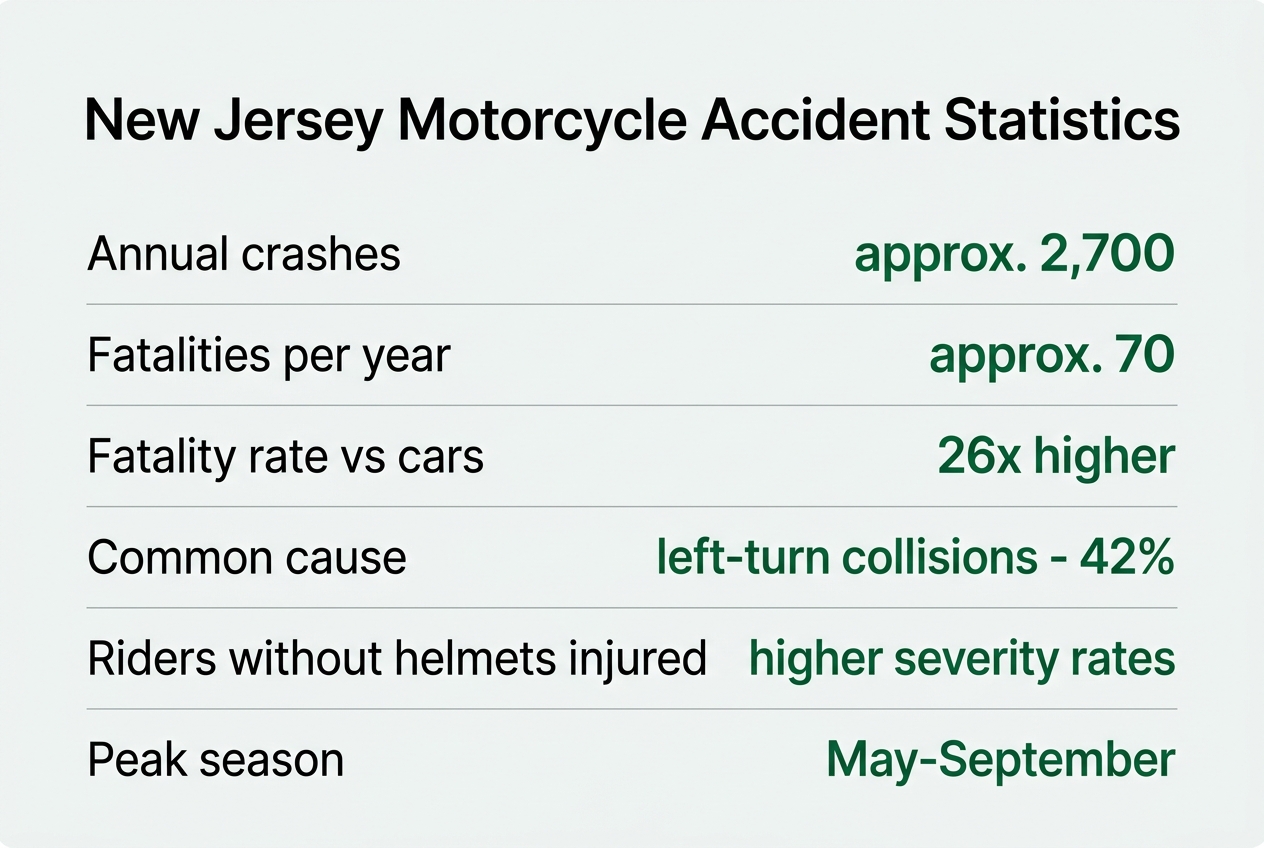
Motorcycles make up a small slice of registered vehicles in New Jersey. Yet riders show up in a wildly disproportionate share of the state’s traffic fatalities every year. That gap isn’t random. It comes down to exposure, visibility, and a handful of recurring crash patterns you’ll see again and again on North Jersey roads. Left-turn collisions at intersections top the list, where a driver misjudges a rider’s speed or simply doesn’t see the bike at all until it’s too late.
Route 80, Route 46, and the busy county roads feeding into Passaic, Bergen, and Essex counties see their share of these incidents. The causes stack on top of each other. Distracted drivers glancing at phones, speeding on stretches drivers know too well, and road hazards like potholes or loose gravel all play a role. Riders also deal with a persistent myth about lane-splitting that leads other motorists to react unpredictably, even though it’s not legally practiced here the way it is in some other states.
A recent 27-year-old motorcyclist killed in early morning crash on a Route 80 ramp in Wayne is a grim reminder of how quickly these situations turn fatal. Crashes like this often share a common thread: a rider who simply wasn’t seen in time.
Comparing Rider Risk to Other Motor Vehicle Occupants
A motorcycle offers no airbags, no crumple zone, no steel cage. Compare that to a sedan involved in one of the common types of car accidents in New Jersey, and the physics tell you everything you need to know about why rider injuries run so much more severe. A fender-bender for a car can mean a life-altering injury for someone on two wheels.
Visibility is the other half of the equation. Motorcycles are narrow. They don’t fill a driver’s peripheral vision the way a car does, and they’re easy to lose in a driver’s blind spot or against a cluttered background. That lack of visibility is one of the single biggest factors behind rider fatalities statewide. Add seasonal timing to the mix — crash numbers climb sharply from April through October, when more riders are on the road and traffic volume peaks — and you get a predictable, dangerous window every year.
Here’s the blunt truth: riders pay a much higher price for the same mistakes other drivers make. A rider tossed from a bike can suffer whiplash and neck trauma much like the symptoms of whiplash after a car accident, but often layered with far more serious impact injuries on top.

New Jersey Motorcycle Accident Statistics You Should Know
The numbers tell a blunt story. NJDOT crash data consistently shows several thousand motorcycle crashes statewide each year, with fatalities running well over 10% of all traffic deaths despite motorcycles making up a small slice of registered vehicles. Most crashes, roughly two-thirds by most annual counts, involve a passenger vehicle failing to see the rider. The rest are single-vehicle wrecks caused by road hazards, speed, or a rider losing control. That split matters, because it shapes how liability gets argued later.
Fatality and Injury Rates by County
Crash density varies a lot by county, and it’s not random. Dense, highway-heavy counties see more collisions, while rural stretches see fewer crashes but often worse outcomes. Here’s a general snapshot of how recent NJDOT-reported trends break down across a handful of counties.
| County | Relative Crash Volume | Common Crash Type | Notable Factor |
|---|---|---|---|
| Passaic | High | Multi-vehicle, intersection | Dense urban corridors, heavy commuter traffic |
| Bergen | High | Multi-vehicle | High traffic volume, frequent lane-change conflicts |
| Essex | High | Multi-vehicle, urban | Congestion, high pedestrian and vehicle mix |
| Ocean | Moderate | Single-vehicle | Higher speeds, seasonal shore traffic |
| Monmouth | Moderate | Mixed | Rural roads plus summer tourist volume |
Helmet use keeps proving itself as the single biggest variable in survival and injury severity. New Jersey requires helmets for all riders, unlike some neighboring states, and riders wearing DOT-compliant helmets consistently show lower rates of severe traumatic brain injury in crash data. Skip the helmet, and the odds shift hard against you. As for who’s getting hurt, younger riders and those with less than three years of riding experience show up disproportionately in injury reports, often tied to unfamiliarity with defensive riding in heavy traffic. If you’re building a claim after a crash, learning about common mistakes that can ruin your personal injury case early on can save you real trouble down the line.
Common Injuries Suffered in Motorcycle Crashes
Motorcycles offer almost no protection when metal meets pavement. Riders absorb the crash directly. The injuries that follow tend to fall into two broad camps: the kind that reshape a life forever, and the kind that heal but still take months of misery to get through.
Catastrophic Injuries
Some injuries change everything overnight. A rider’s head or spine can take the full force of impact, even with a helmet on, and the results are often permanent. Getting a handle on the NJ Motorcycle Accident Overview helps explain why these crashes produce such severe outcomes compared to typical car collisions.
- Traumatic brain injuries and concussions, ranging from mild cognitive fog to lasting memory loss, personality changes, or coma;
- Spinal cord damage that carries a real risk of partial or full paralysis, depending on where along the spine the trauma occurs;
- Severe road rash combined with degloving injuries, where skin and tissue are torn away, often requiring skin grafts and multiple surgeries;
- Compound fractures from high-speed impact, including shattered pelvises and multiple broken ribs that can puncture organs;
- Lower extremity crush injuries caused by the bike itself pinning or landing on a rider’s legs, sometimes leading to amputation.
Recovery from brain trauma alone can stretch out for years. Understanding long term effects from a brain injury matters when you’re trying to plan ahead financially. It’s not just physical, either.
Moderate Injuries
Not every crash ends in the ICU. Plenty of riders walk away with sprains, minor fractures, or bruising that heals in weeks rather than years. But don’t mistake “moderate” for “minor.” Even lower-severity injuries can leave chronic pain, nagging joint problems, or anxiety about riding again. Some victims develop psychological trauma that outlasts the physical wounds entirely. Before signing anything with an insurer, it’s smart to review things to consider when choosing a personal injury att…, since even a “small” injury case can involve real long-term costs. Bodies heal on their own schedule, not the adjuster’s.

What to Do Immediately After a Motorcycle Accident
What you do in the minutes and hours after a crash can shape your entire claim. Motorcycle wrecks happen fast, and so does the scramble that follows. Staying level-headed isn’t easy, but a few clear steps now will save you headaches later.
Steps in the First 24 Hours
Adrenaline hides pain. That’s the honest truth, and it’s why so many riders wave off medical care at the scene, only to discover a fracture or concussion the next day. Handle the basics in order, and don’t skip any of them.
- Get checked by a paramedic or emergency room doctor right away, even if you feel fine, since some injuries like internal bleeding or spinal trauma don’t show symptoms immediately.
- Call the police to the scene and make sure an official crash report gets filed, because that document becomes a key piece of evidence for your claim.
- Photograph the bike, your gear, road conditions, skid marks, traffic signals, and any visible injuries before anything gets moved or cleaned up.
- Collect names, phone numbers, and addresses from witnesses, since their memories fade fast and they may be hard to track down weeks later.
- Write down everything you remember about the crash, including speed, weather, and what the other driver said, while the details are still fresh.
- Notify your own insurer that an accident occurred, but keep the details brief; failing to report at all can create its own complications, and understanding what happens if you don’t report a crash to your carrier is worth knowing before you decide what to say.
Mistakes That Can Hurt Your Claim
Some mistakes are quiet ones. You won’t notice the damage until an adjuster uses your own words against you months later. A recorded statement given too soon, before you know the full extent of your injuries, can lock you into a version of events that doesn’t hold up. Insurance companies aren’t on your side here; that’s simply their job.
Don’t toss your helmet, jacket, or riding boots after the crash, no matter how banged up they look. Damaged gear often tells its own story about impact force and injury severity. This matters even more with head injuries, since proving a traumatic brain injury often depends on physical evidence collected early, not just medical records filed weeks later. Keep the bike itself untouched, too, and resist any pressure to accept a quick settlement before you understand the full cost of your recovery.
New Jersey Motorcycle Laws and Insurance Requirements
New Jersey’s helmet law doesn’t care how old you are or how experienced you think you are. Every rider and every passenger must wear an approved helmet, full stop. Skip it, and you’re not just risking a ticket — you’re handing the insurance company an argument to use against your injury claim later.
Motorcyclists also carry different insurance obligations than car drivers. That distinction matters more than most riders realize, especially after a crash. Understanding personal injury law in New Jersey helps explain why motorcycles are treated separately from passenger vehicles under the state’s insurance scheme.
Requirement Motorcycles Passenger Cars Insurance system Fault-based only No-fault (PIP) available Minimum liability coverage $35,000/person, $70,000/accident $35,000/person, $70,000/accident Medical payments coverage Optional add-on Built into PIP Helmet requirement Mandatory, all ages Not applicable Comparative negligence threshold Barred if 51%+ at fault Barred if 51%+ at fault Fault-Based Claims vs. Underinsured Motorist Coverage
Cars in New Jersey can choose no-fault PIP coverage. Motorcycles can’t. That means every motorcycle claim runs through the fault system, so proving who caused the crash is everything. Comparative negligence rules then decide how much you can actually collect: if you’re found 20% at fault, your award drops 20%. Cross the 51% line, and you get nothing. That’s a harsh cutoff, and insurers push hard to inflate a rider’s share of blame.
This is where underinsured motorist coverage earns its keep. Plenty of drivers carry only the state minimum, which won’t cover a serious motorcycle injury. Riders who add underinsured motorist protection give themselves a backup source of recovery. Severe multi-vehicle crashes, like the one detailed in this Edison, NJ – 2 Killed in Motorcycle Collision on NJ Tpke | report, show how fast liability disputes can spiral when multiple parties are involved. One more number to remember: you generally have two years from the crash date to file a personal injury lawsuit in New Jersey. Miss it, and your claim is likely gone for good.
Determining Liability and Fighting Insurance Company Tactics
Why Insurance Adjusters Undervalue Motorcycle Claims
Bias against riders is real, and it shows up early. Adjusters often assume the motorcyclist was speeding, weaving, or simply “asking for it” just by being on two wheels. That assumption shapes everything that follows — the initial offer, the tone of the phone calls, even how quickly your medical bills get questioned. Fighting that bias starts with knowing it exists. It’s rarely stated outright, but it’s baked into how these claims get handled from day one.
Insurers know riders are often uninsured for their own injuries beyond PIP limits, which makes a quick, lowball settlement tempting when bills are piling up. That’s not an accident. It’s a business model. Similar tension shows up in standard car accident claims, but motorcycle cases draw an extra layer of skepticism because of stereotypes about risk-taking riders that just don’t hold up under real scrutiny.
Add in New Jersey’s comparative negligence rules, and adjusters have a built-in incentive to inflate your share of fault. Shave off 20% here, 30% there — it adds up fast. A claim worth $200,000 can get argued down to $140,000 on paper alone, before anyone even looks at the medical records.
Common Defense Strategies Used to Minimize Payouts
Recorded statements are a classic trap. An adjuster asks friendly, casual questions, then later uses your own words to argue you were distracted or going too fast. Surveillance is another one — don’t be surprised if someone’s watching your social media for a photo that “proves” you’re not really hurt. Quick, lowball offers arrive fast, often before you’ve even seen a specialist, banking on financial pressure to make you sign.
Delay is a tactic too, not just a byproduct of bureaucracy. Insurers sometimes drag out claims hoping medical treatment gaps will make your injury look less serious. It’s a cynical strategy. It also works more often than it should, which is exactly why documentation matters so much.
Value of an Attorney Who Understands Claims-Side Negotiation Tactics
Someone who’s sat on the other side of the table knows which arguments are bluffs and which are real threats. That perspective changes negotiations. Instead of reacting to an adjuster’s opening number, an attorney with claims experience can anticipate the next three moves and counter them before they’re even made.
That insider knowledge also shapes how evidence gets gathered from the start — with the eventual pushback already in mind, not as an afterthought.
Role of Accident Reconstruction and Medical Experts in Proving Fault
Physical evidence doesn’t lie, but it needs an expert to translate it. Accident reconstructionists analyze skid marks, debris fields, bike damage, and helmet cam footage to rebuild the crash sequence second by second. That kind of analysis can directly contradict a police report that leaned too heavily on assumptions about motorcyclists. State data compiled through the Division of Highway Traffic Safety Motorcycle Safety program can also help establish patterns around common crash causes in New Jersey.
Medical experts matter just as much. Orthopedic specialists and neurologists can connect complex injuries directly to the crash, countering any claim that your pain stems from a prior condition.
Importance of Documenting Long-Term Damages, Not Settling Early
Early settlement offers rarely account for surgeries down the road, chronic pain, or lost earning capacity. Once you sign, you can’t go back for more. That’s the whole point of the fast offer.
Thorough documentation — medical records, expert projections, wage statements — protects you from settling for less than your future actually costs.
How a New Jersey Personal Injury Attorney Can Help After a Motorcycle Accident
What to Expect During a Free Case Consultation
Your first meeting after a crash shouldn’t cost you anything, and it shouldn’t feel like a sales pitch. A proper free consultation is really a fact-finding session. You’ll walk through what happened, share medical records if you have them, and get an honest read on whether you have a claim worth pursuing. No pressure, no obligation. Just answers.
A good attorney explains the road ahead in plain language, not legal jargon that leaves you more confused than when you walked in. That means outlining deadlines, describing how New Jersey’s insurance rules apply to motorcyclists specifically, and giving you a realistic sense of timeline. If you’ve been hurt once before and settled a claim, it’s also worth knowing that reopening a closed injury case is sometimes possible under narrow circumstances, and a consultation is the place to raise that question.
Building a strong claim means going beyond your word against the insurance company’s. Serious cases often call in medical specialists to project long-term care costs, economists to calculate lost earning capacity, and accident reconstruction experts to establish exactly how the collision occurred. That last piece matters more than people realize. Tragic outcomes, like the case detailed in coverage of a fatal motorcycle crash on Route 130, show how quickly fault disputes get complicated when there’s no independent reconstruction of the scene.
Once the documentation is in place, the real fight begins: negotiating with insurers and defense counsel who don’t have your best interests at heart. That’s their job, honestly. Yours is to have someone in your corner who’s done this before and won’t cave to a lowball offer. This kind of representation is available to riders across Passaic, Bergen, Hudson, Essex, Middlesex, Mercer, Morris, Monmouth, Somerset, and Hunterdon counties, wherever the crash happened. And through it all, you should hear from your legal team regularly, not just when there’s a check to sign.
If you’re a rider still piecing together what happened on a New Jersey road, the most useful next step is usually gathering the practical details — the crash report, medical records, photos of the bike and the scene — before memories fade and evidence disappears. Attorneys who handle motorcycle cases specifically can speak to the unique biases riders face, while a firm like Weiner Mazzei, which handles car accident claims and catastrophic loss matters in northern New Jersey, would be worth asking directly whether a motorcycle collision fits within their motor vehicle work. Either way, understanding your options early tends to matter far more than how quickly you settle.